“… it is notable that someone in his position would be sensitive
to the plight of a mere undergraduate.”
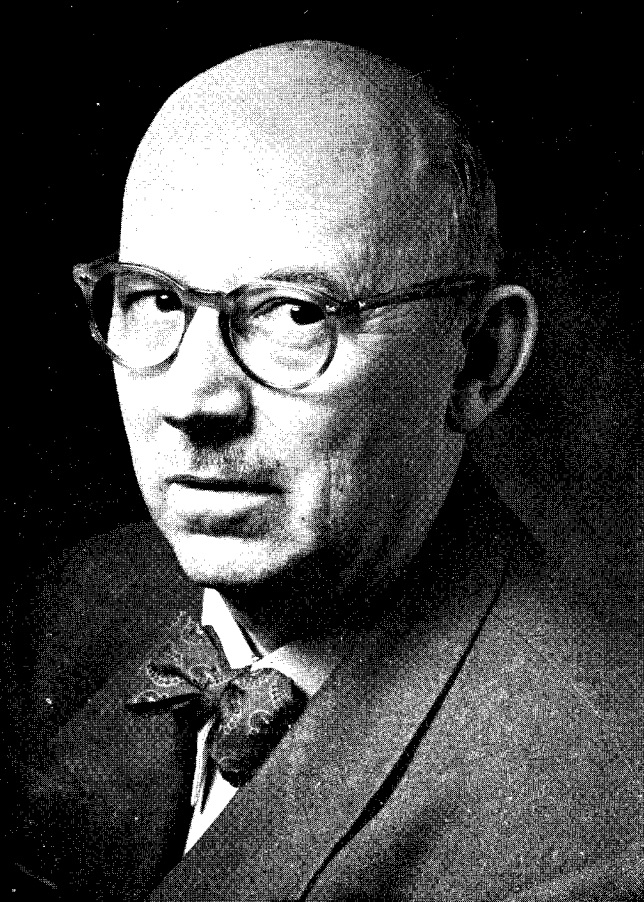
Prof. Wendell Latimer
(1893-1955)
Dean of the College of Chemistry, 1941-1946, Chairman, 1945-1949
University of California, Berkeley
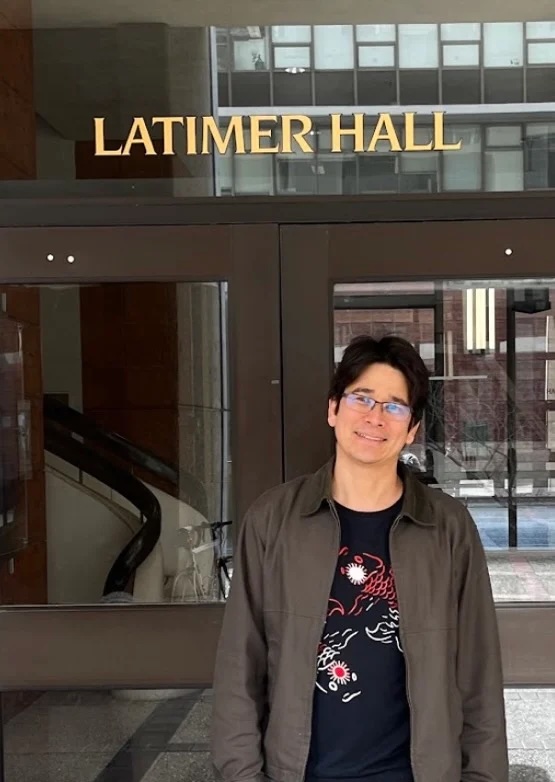
By Arlo Faria
My grandfather studied at UC Berkeley,
where some lessons in basic humanity
can be as remarkable as the scientific discoveries.
Like other Japanese American students whose lives were disrupted in 1942, Cromwell Mukai was removed from a college campus to the horse stables at Tanforan, then transferred to the Topaz camp in Utah. Exceptionally, though, he stayed only five days in Topaz before continuing his journey further inland to the University of Nebraska, where he would continue his studies. The opportunity for him to leave the camp resulted from a letter of recommendation written by Professor Wendell Latimer. Our family will forever remember that man, an educator who demonstrated extraordinary care for all students. Beyond one powerful individual, however, this is also the story of a community and an institution that took positive action to address injustice.
Having grown up on a farm in San Diego, my grandfather must have been enthralled to end up at Berkeley’s chemistry department during what would be its most impactful time in history. Their cyclotron had just produced a new element, plutonium; berkelium and californium would later add to this legacy. In 1941, following Gilbert Lewis (of “Lewis dots” fame), Prof. Latimer became the dean of a faculty that included renowned figures such as Glenn Seaborg (of seaborgium fame) who had just started his half-century professorship, and Melvin Calvin (namesake of the photosynthesis cycle) was my grandfather’s teaching instructor. Latimer would also oversee Berkeley’s involvement in the top-secret Manhattan Project. With such consequential responsibilities at the time, it is notable that someone in his position would be sensitive to the plight of a mere undergraduate.
Similar advocacy by Linus Pauling at Caltech is well documented, and the Student Relocation Committee at Stiles Hall was an influence at Berkeley, among many factors that led to the creation of the National Japanese Student Relocation Council (NJSRC) managed by the American Friends Service Committee (AFSC) of the Quakers. This ultimately relocated thousands of Japanese Americans throughout educational institutions east of the Rockies. Nonetheless, my grandfather was one of the first such cases and he was specifically most grateful to Prof. Latimer, publicly thanking him in the Class Notes section of an alumni magazine.
My grandmother also had some influence. A graduate of Berkeley High School, Kyoko Hoshiga earned degrees in music performance and had taken piano lessons with Mrs. Helen Crawford, who was married to the head of Berkeley’s astronomy department. Among the close-knit faculty at the time, Profs. Crawford and Latimer were colleagues who played chess regularly. My mother would later learn that Mrs. Crawford had told her husband to urge Prof. Latimer to get my grandfather out of the camps. Perhaps it was this woman’s more personal behind-the-scenes advocacy that most directly benefited our family.
Growing up, I first learned this history in the context of college football in my grandparents’ home on the East Coast. I was confused why Grandpa watched the televised Nebraska Cornhuskers games on Saturdays, but also looked up scores for the Cal Bears in the Sunday papers. He explained his dual allegiances without dwelling on the context of the war and relocation, but what I remember best was this clarification: Nebraska was an athletic powerhouse in the midst of historic dominance during the mid-1990s, but Berkeley would always be the preeminent research university. That influence led me to enroll at Berkeley, and I am glad that my grandfather was able to see me achieve this milestone before he passed away in 2002 — even if it wasn’t entirely clear to me whether it was technically his alma mater.
The University of California is famed for not awarding honorary degrees. Since the regents established the policy in 1972, there has been only one exception: UC Berkeley conferred honorary degrees to all of the Japanese American students forced to leave during the war. In 2009, I walked on the stage to receive this posthumous honor on my grandfather’s behalf. My family greatly appreciated this gesture, which formalized the support of an institution — for me, it finally resolved any administrative ambiguity there may have been about which school my grandfather belonged to.
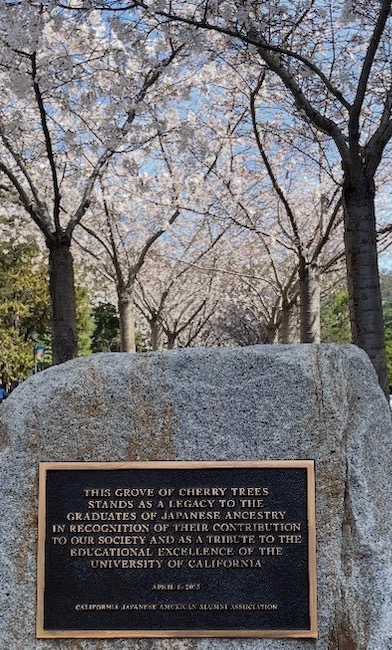
I now live in Berkeley and hear echoes of the past, such as crossing MLK, Jr. Blvd. — previously known as Grove Street, a boundary enacting racially segregated redlining laws that prevented previous generations of Japanese Americans from living on the streets where I now reside. On campus in the spring, I can walk past Latimer Hall and see the cherry blossoms of a tree-lined monument honoring the Japanese American students.
It makes me hopeful to be in a place where a community of extraordinary individuals can form an institution that advances both science and humanity.
© 2026, Arlo Faria
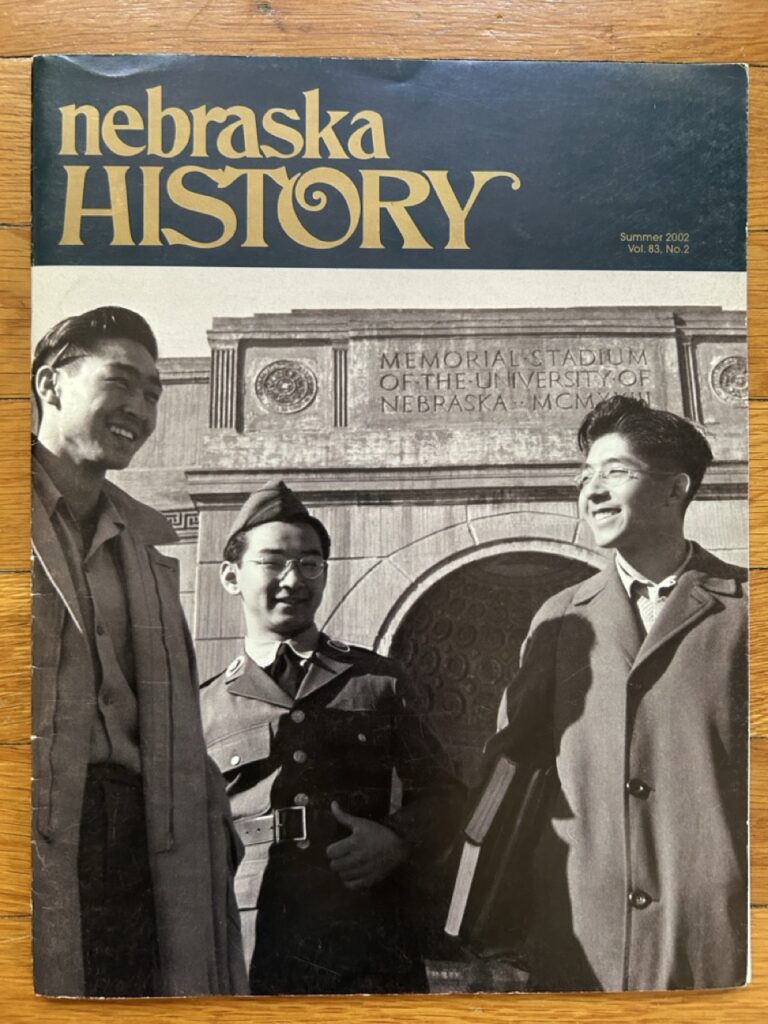
Arlo Faria is a Yonsei who was born in Brazil. “In 2010 on a cross-country road trip, my sister Quinha and I stopped in the Nebraska State Historical Society, which published an article about the Japanese American students who studied there during WWII. They gave us this issue of Nebraska History, which shows our grandfather on the right with Joe Nishimura and John Mitsumori on its cover.”
ODG Post-story note:
The Student Relocation Council and the National Japanese American Student Relocation Council (JASRC):
Located next to the Berkeley campus, Stiles Hall has had an established history of progressive work with students and the community since 1884. At the time of WWII, a local YMCA was headquartered there, and Henry Kingman was director. In a 1973 recorded oral history (1), Kingman recounted the first meeting of the “Student Relocation Council,” held on March 21, 1942. With $500 from the regional Y, he suggested hiring Joseph Conard, a Quaker graduate student he knew, to help work on the relocation of Japanese American students. In his Stiles Hall YMCA position, Kingman had had many years of coordinated work with university officials. His wife, Ruth, was Executive Secretary of the Pacific Coast Committee on American Principles and Fair Play, of which an estimated one-fifth of its members were associated with Stiles Hall (2). According to Berkeley historian Chuck Wollenberg (email communication, April 28, 2026), the original Student Relocation Council and the Kingmans lobbied Robert Gordon Sproul, the President of the University of California, to support the transfer of Japanese American students to colleges east, and this was an important factor in convincing the Roosevelt administration to agree. Sproul wrote to more than 30 Midwest colleges and universities(3), and 75 students were relocated during the “voluntary evacuation” deadline of March 29, 1942 according to a 1945 academic article which also reported, “Before evacuation, the YMCA-YWCA, the Pacific College Association, educators–such as President Robert Gordon Sproul of the University of California, President Lee Paul Sieg of the University of Washington, and President Remsen Bird of Occidental College–and others gave much time and attention to the problems of the student group.(4)”
On May 27, 1942, in a meeting in Chicago, which was attended by university and college officials, religious groups and others, it was agreed that the “Student Relocation Council” would become the NJASRC – National Japanese American Student Relocation Council, coordinated by the Quaker’s American Friends Service Committee (AFSC), and by early 1943 was centrally headquartered in Philadelphia. During the war, the AFSC arranged and facilitated college study of more than 4,000 young Nisei women and men, giving them life-changing opportunities (5). One of the stories appears here in the ODG project about a young man who studied at Colby College in Maine.
In tribute to the NJASRC work of the American Friends Service Committee, a “Nisei Student Relocation Commemorative Fund” (NSRCF) was formed in 1980, with monetary grants to students from underserved communities. The website is: https://www.nsrcfund.org/about .
References and for further interest:
(1) Kingman, H. L. (1973, February 26). The Japanese American Student Relocation Council (R. Levenson, Interviewer) [Transcript]. In Citizenship in a democracy (pp. 47–49). The Bancroft Library, University of California, Berkeley. https://digicoll.lib.berkeley.edu/record/217283?ln=en&v=pdf
(2) Story of Stiles Hall: University YMCA in Berkeley aids Nisei during war years Berkeley, Calif. (1973). In H. L. Kingman, Citizenship in a democracy (Appendix p. 259). The Bancroft Library, University of California, Berkeley. https://digicoll.lib.berkeley.edu/record/217283?ln=en&v=pdf (Reprinted from Pacific Citizen, 1949, April 12)
(3) Kell, G. (1917, April 24). Campus, city to mark WWII internment of Japanese Americans, 75 years on.” UC Berkeley News. https://news.berkeley.edu/2017/04/24/campus-city-to-mark-wwii-evacuation-of-japanese-americans-75-years-on/ (The author includes information from a 1995 project at the Berkeley Historical Society conducted by T. Robert Yamada.)
(4) Provinse, J.H. (1945, April 16). Relocation of Japanese-American college students: acceptance of a challenge. Higher Education 1(8):1-4. https://lib.uw.edu/specialcollections/collections/exhibits/harmony/interrupted/text/provinse
(5) Austin, A. (2026, April 28). National Japanese American Student Relocation Council. Denshō. https://encyclopedia.densho.org/National_Japanese_American_Student_Relocation_Council/