Our Debt of Gratitude
Stories about people of non-Japanese ancestry
who helped Japanese Americans
during the WWII forced removal from the West Coast,
mass incarceration in concentration camps and prisons,
and the nationwide denial of civil rights
Honoring Those Who Stepped Forward Against Injustice
About the Project
We gather personal stories of assistance and compassion, about individuals of non-Japanese ancestry who came forward to help Japanese Americans during the World War II racist hysteria, forced removal from the West Coast, and mass incarceration. We also welcome helper narratives about the Japanese Americans who were outside of the West Coast under intense government-ordered restrictions and denied civil rights while most were not incarcerated at confinement sites.
These stories honor those of non-Japanese ancestry who stepped forward against the tide of racism. We hope they enhance conversation about personal conviction, and encourage similar helper actions when an injustice is being done to another person.
Our website focuses on short written accounts from those wishing to express their thanks and admiration to honor individuals who were a part of their own life histories or touched them so. We have found that even the simplest story can be as profoundly moving as any other. These are stories motivated by someone’s longing to express a deep sentiment of appreciation, their own or shared by another. While most are written by Japanese Americans, others have been sent in by non-Nikkei (those of non-Japanese ancestry), who have had our stories in their lives. If you feel there is someone missing from this collection of stories, please send in your story about them to this ongoing, collaborative project.
The Our Debt of Gratitude Project began in mid-2025 and presents its first set of stories here.
Do you have a story to contribute?
The Our Debt of Gratitude project aims to share personal stories of short length,
from one paragraph to about 800 words maximum. Many of the stories have been passed down in families, or they are stories found within records and letters we are still discovering. You do not have to be Japanese American to contribute a story, but please include how the people or the story personally touched or inspired you to write.
In 2026, the closing date for story submissions is October 31, 2026.
For further details and guidelines, please click here or on the green box at right.
“Send Your Story” can also be accessed from the blue header of each webpage.
Collecting Stories of Courage and Kindness
The Our Debt of Gratitude project is fueled by stories that want to be told: in a time when immigrant lives and civil rights of different groups are once again increasingly challenged, our full Japanese American history can encourage acts of courage and help to all groups of people now found in the recurring divisiveness we once experienced.
For many Japanese American families, it took decades for elders to speak of their personal hardships during the forced World War II relocation and incarceration of Japanese Americans. Once shared, their stories have helped subsequent Nikkei generations understand the strength and resilience of our pioneering Issei and Nisei. For others, those stories shed light on the injustices faced by a peaceful civilian population that was targeted by race and wartime hysteria.
Now, we turn to another vital aspect of this history: remarkable acts of compassion and solidarity shown by individuals of non-Japanese ancestry during the hysteria following Pearl Harbor, when the government turned upon its own citizens and law-abiding immigrants in issuing Executive Order 9066. Some non-Nikkei stood up, reached out and offered support to Japanese American friends, neighbors, students, and even strangers.
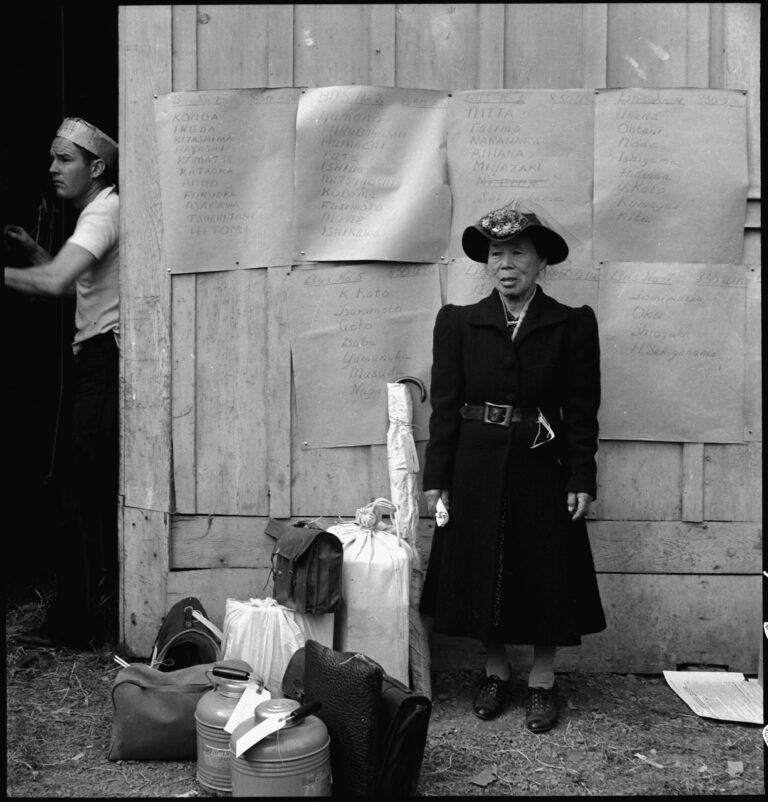
Imagine being uprooted from your home,
instructed to take only what you could carry …
And someone stopped by to try to understand.
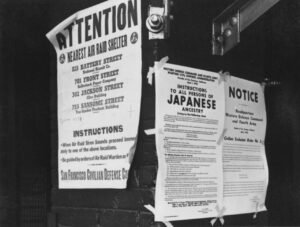

While many Japanese American families endured profound losses with no one to turn to, some were extended a helping hand or a kind favor by a non-Nikkei individual, someone who came forward amid the hysteria and hatred when our families and communities were being forcibly uprooted and removed from the West Coast. They did things like rented out our farms to pay the land taxes, maintained ways for us to return to something of our homes and businesses, selflessly sought possible alternatives to longterm incarceration, or faithfully extended a kindness while our families were being quickly corralled away. East of the Pacific coastal regions, the severity of restricted Japanese American civil rights were recognized by some non-Nikkei in actions of goodwill that helped our families endure.
These individuals could not prevent the mass incarceration of West Coast residents and nationwide government-enforced restrictions, but their acts of help, large and small, made an immeasurable difference for Japanese American generations to come. The effects of their unforgotten courage and compassion are still treasured today in family stories passed down. These non-Nikkei individuals showed up despite risks of their own surveillance by the FBI and taunts from their own neighbors of being traitors themselves. Some could not publicly show up, but found a way behind the scenes to come forth to help, or to give a Japanese American family a quick but lasting break, hoping no one was looking. They acted.
Helpers are healers
Generations later, these personal stories of help and empathy offer a different kind of healing. Beyond the narratives of hardships, they illuminate instances of decency and fairness that emerged from a period of profound injustice. Some descendants of early Issei and Nisei have said that in growing up, although little was said about the concentration camps, certain names were heard repeated again and again, in recounting “what these folks did for us,” and visits would be made to non-Nikkei families to show that their appreciation continued with the presence of younger generations, in an unforgettable debt of gratitude.
For the present-day generations of Japanese American ancestry, these stories help heal the intergenerational wounds from racial division stoked during a dark chapter of American history.
For those of non-Japanese ancestry
These stories awaken pride in the acts of decency and fairness, of courage and kindness that came from their own communities, inviting curiosity into our full American history.
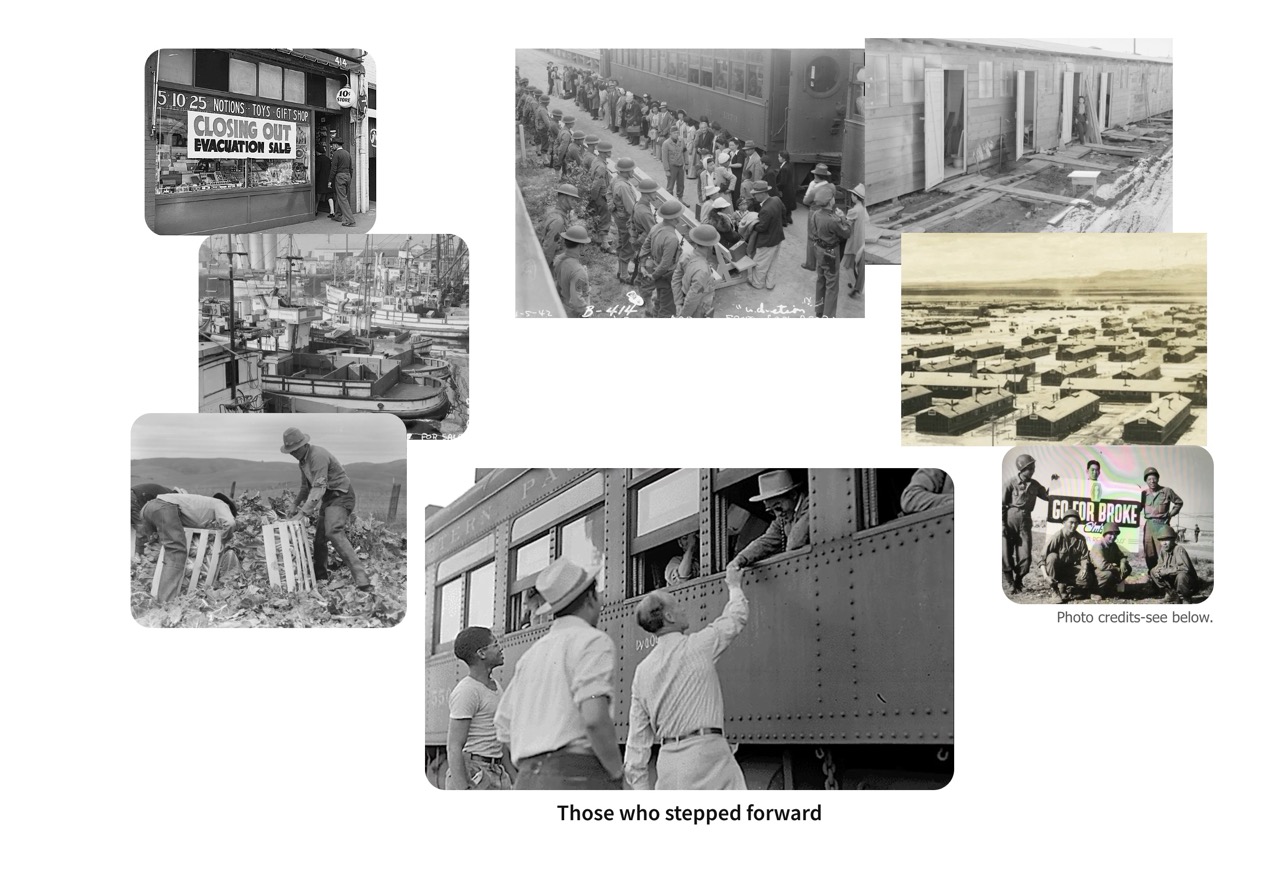
Photo credits for this page: Black and white photos on this webpage are from the National Archives and Research Administration except for the Go For Broke photo, courtesy of the late George T. Mukai. The yellowed B&W photo is “Aerial View of Topaz” (ddr-manz-4-127), courtesy of Manzanar National Historic Site and the Shinjo Nagatoni Collection, Denshõ Digital Collection, licensed under a Creative Commons Attribution-Non-Commercial-Share-Alike 4.0 International License. Color photos courtesy of ODG Project. Top container and footer art ©2008, Sumiye Okoshi.
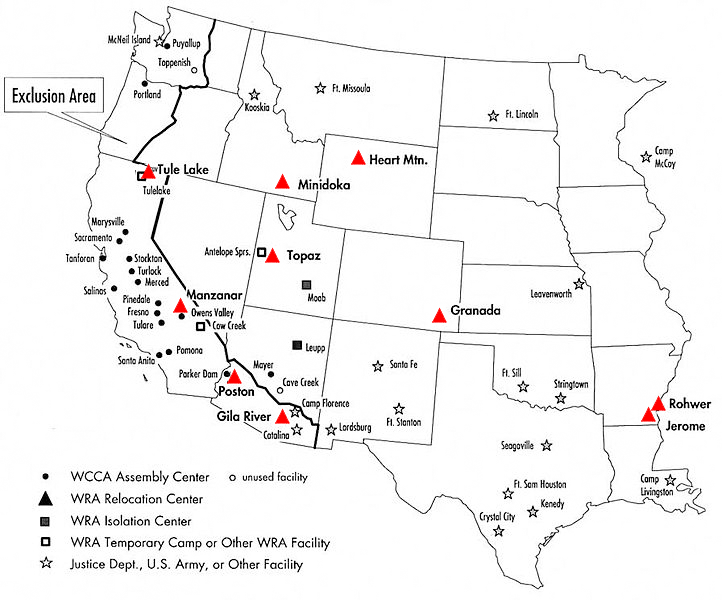
Note: “Japanese American” is used here to refer to both immigrants from Japan and US-born citizens of Japanese ancestry. We assume the reader has a basic knowledge of the mass removal of Japanese Americans from the West Coast and the incarceration, and resettlement of Japanese Americans during the WWII and post-war era. If needed, Denshō’s Introduction to WWII Incarceration may be helpful, as well as: “Rachel Maddow Presents: Burn Order ” podcast series of 2026. For reference as you read the stories, a map of WWII Japanese American incarceration sites and some Japanese terms used in the stories are found at the lower end of each Table of Contents page.
Project Organizers
Margret Mukai
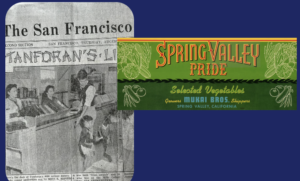
Currently based in Philadelphia, Margret Mukai is a retired RN and Family Nurse Practitioner, with a former career as an agricultural research scientist. She grew up in New York and New Jersey, hearing of the Crowningshield neighbors in Spring Valley, California, who rented out the Mukai farm to pay their land taxes, lest the farm be forfeited for non-payment of taxes during WWII. Collecting the rent was no easy matter. The renters, immigrants themselves, said they didn’t have to pay because the Mukais were gone.
Her mother always spoke in awe of the Mills College librarian, Evelyn Steel Little, the “guiding light” for the Tanforan Library, whose story is found on this website.
Margret’s parents and grandparents were incarcerated at Tanforan and Topaz, Lordsburg and Santa Fe, and Poston. One set of grandparents returned to California after the war, while the other two resettled in Chicago. She and her uncle, George T. Mukai, the last known 442nd veteran residing in NYC, watched out for each other during his last 17 years.
Sandra Buscher
Sandra Mikesell Buscher is a lifelong writer. She taught a class called “Capture the Moment in Words” at her town’s Senior Citizen Center in Bethel, Connecticut, for 28 years. Her class was designed to help others write their own stories. When encountering people who say, “No one in my family is interested in my stories,” she responds, “The person who will want to read them might not be born yet.” That is the beauty of writing a story down – it allows future generations to hear the stories we preserve.
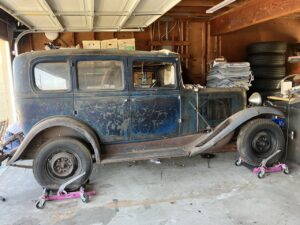
A hapa Sansei, Sandra is excited to help facilitate the preservation of “Helper” stories. Her grandfather Masaichiro Marumoto led a caravan of three cars (his own family’s car, pictured above) to Utah during the Voluntary Relocation period to avoid incarceration in a WRA camp. Her mother, Yukari Mikesell, who was six years old when they moved to Utah, calls the farmer’s wife who hired them “Grandma Thurgood.” Even 83 years later, Yukari says, “Grandma Thurgood never slaughtered a chicken for her family without giving one to my mother to cook. She never baked a loaf of bread without giving one to my mother for our family. She was the only grandma I ever had.” Grandma Thurgood’s kindness lives on in those memories.
Project Helpers
We are a volunteer-run project. Our thanks for the precious time, generous efforts, and critical suggestions, opinions and care in the creation of this website:
* for Japanese cultural clarification of the concepts of ongi and kansha, and wasure enu ongi: Emy & Yasuo Kamihara of Montclair, NJ.
—for the space to raise new ideas: JAMP-Japanese American Memorial Pilgrimages.
—to JACL and Pacific Citizen, JANM, Go For Broke Natl. Educational Center, JAA-NY, Nichibei Times, senior citizens groups, The Univ. of Penn. Law School IP Clinic, and the many organizations and individuals who contributed in significant ways, including those not directly contacted.
—to professional authors, academics, librarians and archivists, historical and cultural groups, and to independent historians, researchers and volunteers who established work on stories of gratitude before this project, and for this project.
–to contributors of the stories, information and images for our stories, and to those who assisted with research and rights permissions.
–to our final website reviewers: Quinha Faria, Ryan Wyndus, Tatiana, Kurt Ikeda, Barbara Goto, Lúcia Pascone and Kathy Woods.
—to those who have fought to correct history, worked to establish Japanese American history, and continue to do so.