“At the time, Reverend Buckham’s sympathies were not supported by a large contingent of the CCSM Congregation. And now, looking back on this time,
the support CCSM offered remains one of our church’s most courageous and prominent moments”(1).
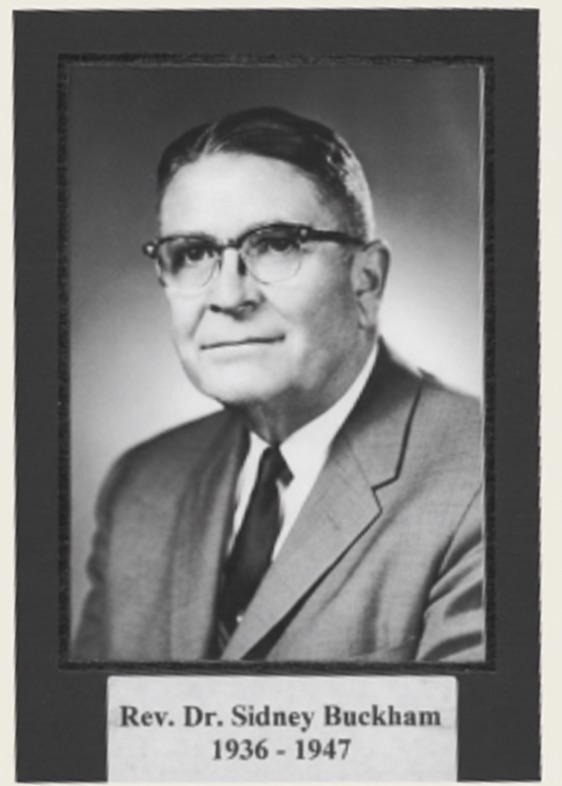
Photo used with permission from Congregational Church of San Mateo, 225 Tilton Ave, San Mateo, CA 94401
Rev. Dr. Sidney Buckham
Congregational Church of San Mateo (CCSM)
The ODG Project with
Melodie Lew,
member of Congregational Church of San Mateo
In the early 1900s, a number of Japanese-language churches started out by meeting in members’ homes before they could secure a building. In 1924, Congregational Church of San Mateo (CCSM) invited the Japanese Independent Union Church to hold Japanese-language worship services in the CCSM Sanctuary, to conduct a children’s Sunday School on their premises, and if desired, to attend worship with CCSM in English. By 1938 the Japanese Union Church had constructed their first building, Sturge Memorial Cottage, but still maintained close ties to CCSM(2,3).
Then began World War II. Amid the hysteria, just nine days after Pearl Harbor in Dec 1941, Rev. Sidney Buckham of Congregational Church of San Mateo (CCSM) issued a public statement that CCSM “renews its welcome to the Japanese Union Church to continue to worship in our church. We pledge ourselves to keep unbroken the bond of Christian fellowship with your church as an essential expression of our belief in the Fatherhood of God, and the brotherhood of all men”(2).
Following Executive Order 9066 in Feb 1942, six members of the Japanese Union Church applied for membership in CCSM. The Trustees meeting minutes read, “It was the unanimous opinion of those present that they should be accepted into membership and that the church committee would be ready to answer any criticism that might arise”(2).
CCSM offered church attic space to store the belongings of Japanese families while they were gone during the war. (The Japanese Union Church used its Sturge Memorial Cottage for the same, and later would use it as a hostel for Japanese Americans with no place to live when they returned, but its space was limited) (2,3). Most of the Japanese Americans in the San Mateo area were incarcerated first at the temporary Tanforan Assembly Center (Tanforan Racetrack) in San Bruno. Rev. Buckham visited them there a number of times, and also made the long trip to Topaz Incarceration Center in Utah(1).
“The Past, Prelude to the Future” is the theme of the anniversary book of Congregational Church of San Mateo, Celebrating 150 Years of Progressive Faith in Action, published in 2014. In looking back at the incarceration of those of Japanese descent during WWII, the authors recognized, “At the time, Reverend Buckham’s sympathies were not supported by a large contingent of the CCSM Congregation. And now, looking back on this time, the support CCSM offered remains one of our church’s most courageous and prominent moments”(1).
The 150th year church anniversary book includes excerpts from the 2003 and 2005 personal interviews of two Japanese American church members, Martha Imai (1915-unknown) and Shig Takahashi (1913-2011), who each gratefully remembered the enduring help that CCSM supported the Japanese American community throughout and after the war(4,5).
While her Issei parents had attended the Japanese Union Church in San Mateo before WWII, Martha Imai had grown up attending CCSM church school. She was particularly grateful for the storage space that CCSM offered the Japanese community during WWII, arranged under the leadership of Rev. Buckham(4). Many families on the West Coast returned to nothing.
Shig Takahashi recalled how Rev. Buckham had twice made the long trip to Topaz to see how Japanese Americans were being treated. He recounted that as the Japanese were returning to San Mateo, “Rev. Buckham had a meeting when we came back to this welcomed place. He had a representative from the Jewish, the Catholic, the black church, and he had just about every different denomination represented. They asked each one of the clergymen what they think (sic) about the camp. They all agreed that they would welcome the Japanese to come back”(5).
Rev. Buckham rented out the Takahashi’s house to others during the war years. When the Takahashi family returned to San Mateo after the war, the renters had left their house “a mess” and all their belongings that had been stored in the garage had been stolen – a common story throughout the West Coast. Since Rev. Buckham had been unable to enter the house, he never saw that the renters had done things like “put water all over the inside.” Shig Takahashi wrote that he never told this to Rev. Buckham because he didn’t want him to feel badly. “We were lucky, our house was still standing, (as) other friends in the country had their houses set on fire…“ I thought about what the Germans did and I felt some of the same things were happening here at home. People never knew that because we never say it”(5).
Three decades later, in an interview during the mid-1970’s, Rev. Buckham reflected:
“I would say one of my major defeats in a certain sense was during World War II when the Japanese were under criticism. The American-born Japanese were put in what I would call concentration camps and I was under rather heavy criticism in the First Congregational Church in San Mateo because I was friendly to the American-born Japanese and felt that they were being mistreated by being sent away from their homes, having their property taken away from them when they were really very loyal American people. They could not become citizens but they were loyal to this country. So I was under heavy criticism, but I stayed with my conviction and in the end received the plaudits of the people because of the stand I had taken”(6).
© 2026, ODG Project
Sources, and for further interest:
(1) Mader-Clark, A., Mullery, L., Neil, C. S., & Louden, K. (2014). Congregational Church of San Mateo: Celebrating 150 years of progressive faith in action. MAC Publishing, p.23. https://ccsm-ucc.org/wp-content/uploads/2020/08/150th-Anniversary-book-and-front-cover.pdf
(2) Lind, P. (2024). Sturge 100. The Pine Tree, 73(7), 24. https://ccsm-ucc.org/wp-content/uploads/2024/11/thepine-tree-vol73-issue07.pdf
(3) Buchanon, P. D. (2001, December 10). Church strengthens spirituality in all. The Daily Journal. https://www.smdailyjournal.com/news/local/san-mateo-s-1st-japanese-christian-church-celebrates-100th-anniversary/article_4079ac44-884a-11ef-a10a-b391022699c0.html
(4) Mader-Clark et al., (2014). “Martha Imai,” pp.54-55.
(5) Mader-Clark et al., (2014). “Shig Takahashi,” pp. 51-53.
(6) Mader-Clark et al., (2014). “Postscript by Rev. Buckham,” p.54.
Melodie Lew, a member of Congregational Church of San Mateo, contacted the ODG project, and gathered information, documents and permissions from the church historian and others for this story and the next (“Mr. and Mrs. Lupton”), contributing her guidance and editing. Permission to use excerpts and photos from CCSM publications was graciously granted from Congregational Church of San Mateo, 225 Tilton Ave., San Mateo, CA 94401.