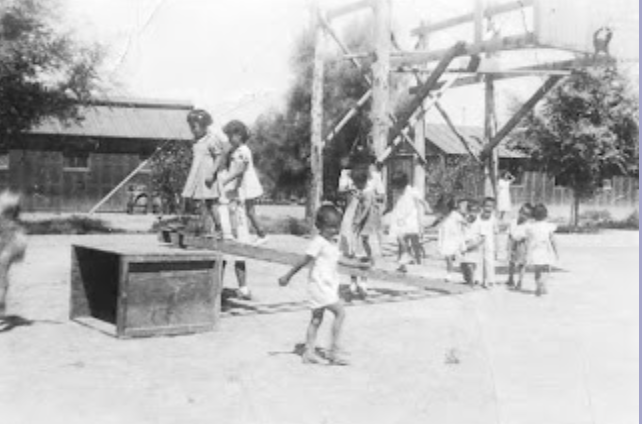
“the dairyman friend … drove his truck from Salinas to Arizona to bring …
a long sheet metal that was needed for the playground slide”
Charlie Marci
(1921-2006)
He wanted children to have their childhood fun.
He saved the Iwamoto home from auction.
By Y. Caryl Suzuki
Saburo & Toshiko Iwamoto lived on Lake Street where their home was located across the street from the Pet Milk Company in Salinas, California. A Swiss dairy farmer, Charlie Marci, would bring the milk from his dairy cows each business day. While he waited to have his truck unloaded, he befriended Saburo Iwamoto, a Nisei truck driver who lived across the street from the Pet Milk Company.
When the Iwamoto family was sent to Poston, the dairyman friend kept in touch and drove his truck from Salinas to Arizona to bring the incarcerated Japanese American children a long sheet metal that was needed for the playground slide, among other useful items.
Mr. Marci also paid the necessary property taxes so that the Iwamoto home could not be put up for auction.
Once WWII was over, the Japanese American family returned to Salinas and each Christmas gave an appreciative gift to that dairyman over the later years for his loyal friendship and help.
© 2025, Y. Caryl Suzuki
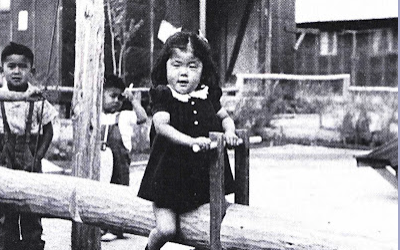
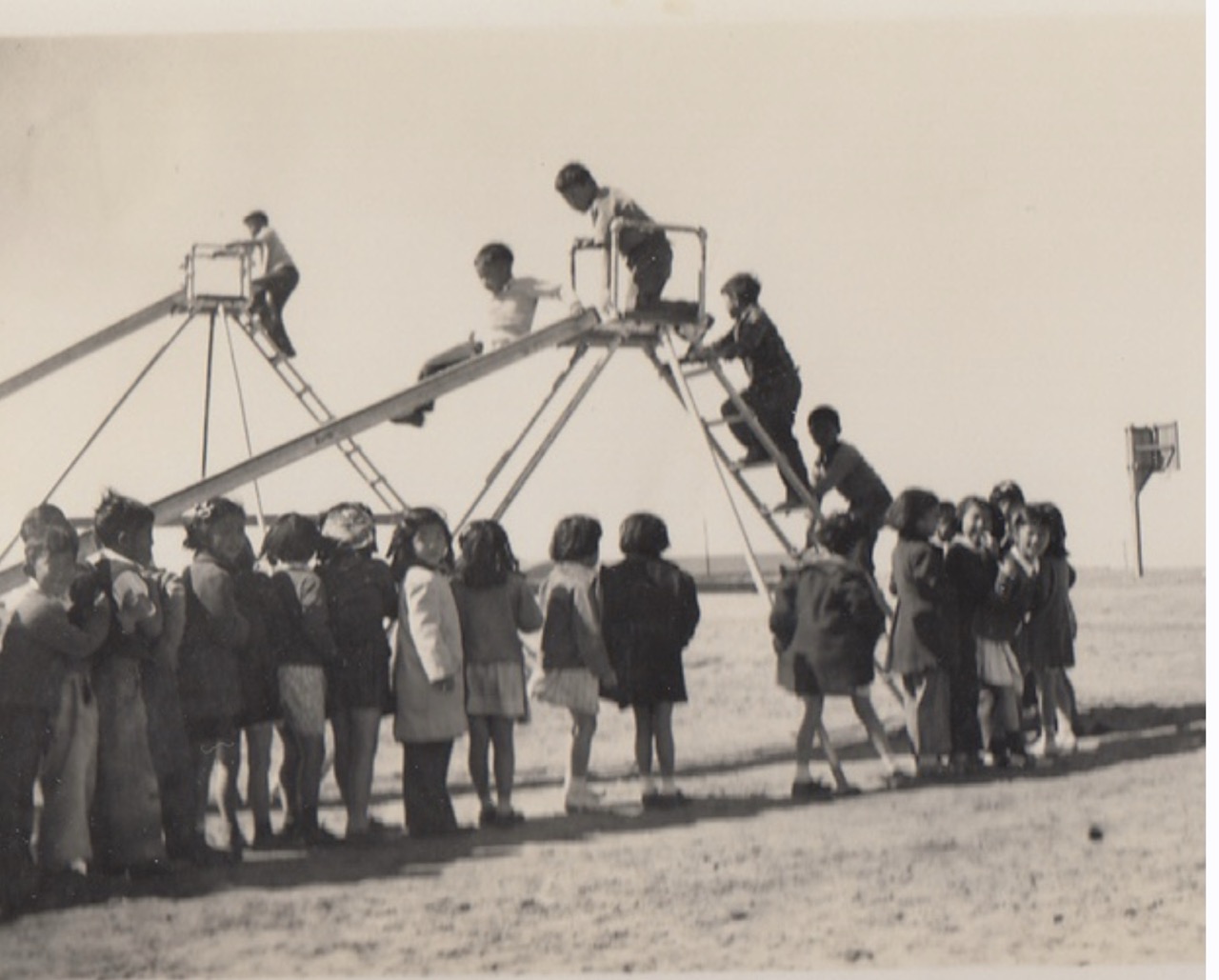
While the ODG Project was unable to locate a photo of the Poston children’s slide made with Charlie Marci’s sheet metal, we did find the photo on the right, showing the popularity of the playground slides at Amache in Colorado! Photo courtesy of Jean Coates and Mitch Homma.
About Caryl Suzuki: (Yoko) Caryl Iwamoto was born in Poston Internment Camp, Arizona. Unlike the vast majority of Japanese Americans forcibly removed from Salinas during WWII**, after the war her family was able to move back to Salinas. There she grew up and attended Salinas High School.
After graduating from UCLA, she married, and – as Caryl Suzuki – first taught in the San Diego School District. In the late 1960s-1970s, California began encouraging “minorities” to apply for public school administrative positions. She was accepted into the Carnegie Administrative Program for Women and Minorities. With her Master’s in Education, she became Vice Principal of a junior high school in Los Angeles, where she worked for six years.
In 1983 the position of principal opened in Salinas for Washington Junior High School, which she had attended as a student. Due to the particularly harsh historical experience of Japanese Americans in Salinas, her mother was hesitant about having Caryl back in Salinas and told her to stay in southern California. Well-qualified, Caryl fit the need for minority administrators and became the first Asian American principal hired in Salinas, in a school in which the faculty still included a few teachers who had had Caryl as a former student in their classes.
Caryl’s parents still had doubts about her accepting any principalship; they felt that she should keep a low profile since the Japanese Americans in Salinas were barely accepted as honorable citizens after they were all sent to the Poston concentration camp during the WWII Internment. While working full-time and raising a family, Caryl completed her Ed.D. After seven years as a middle school principal, Caryl found that the advancement possibilities for her in Salinas were limited. She moved her family to Las Vegas, where she served as a secondary school principal. She retired in 2016 after 50 years in public school education. She currently volunteers at her church and goes to the gym five days a week. She and her husband, a retired airline captain, have two sons and four grandchildren (March 2026).
ODG Post-story Note: The above author biography was extended beyond the usual project length to acknowledge the very absence of women of color in public school administration in Caryl’s time, and to give an example of the initial programs during the 1960s intended to increase opportunities in administration in which minority populations had not been represented. We applaud Caryl Suzuki for her 50 years of service to public education.
For Reference and further interest:
McKibben, C. L. (2022). Salinas: a history of race and resilience in an agricultural city, Stanford University Press.
**”Only 25 of the over 300 original Salinas Japanese American families returned after incarceration …” (McKibben, 2022, p.199).
The Salinas and Pajaro Valleys were also the home of 105 men of the 194th Tank Battalion forced into the Bataan Death March in April 1942, of which 47 survived. The Bataan Memorial in Salinas was dedicated to these men in April 2006 (McKibben, 2022, p.14).
* Carol Takahashi, who granted permission to use the feature photo, is the daughter of Joe Takahashi, in the foreground.
The exceptionally moving and profound story of her grandparents, Yoneguma and Kiyoka Takahashi, and their family, and the beautifully-crafted, well-known “Takahashi bird pins”, is presented in her website (link below) and in the book, The Inspiring Story of the Takahashi Bird Pins, by Julia C. Carroll and Carol Takahashi, published in 2010 by Collector Books. http://www.takahashibirds.com/the_artists.html