“We sang our hearts out for another forty minutes …. She only had permission to visit until four o’clock, when she had to check out at the guard gate.”
“Later I heard from some of the gang that Mr. and Mrs. Fisk had been having a hard time back in Guadalupe because they’d been kind to us Japanese .… They said someone threw rocks at their windows …”
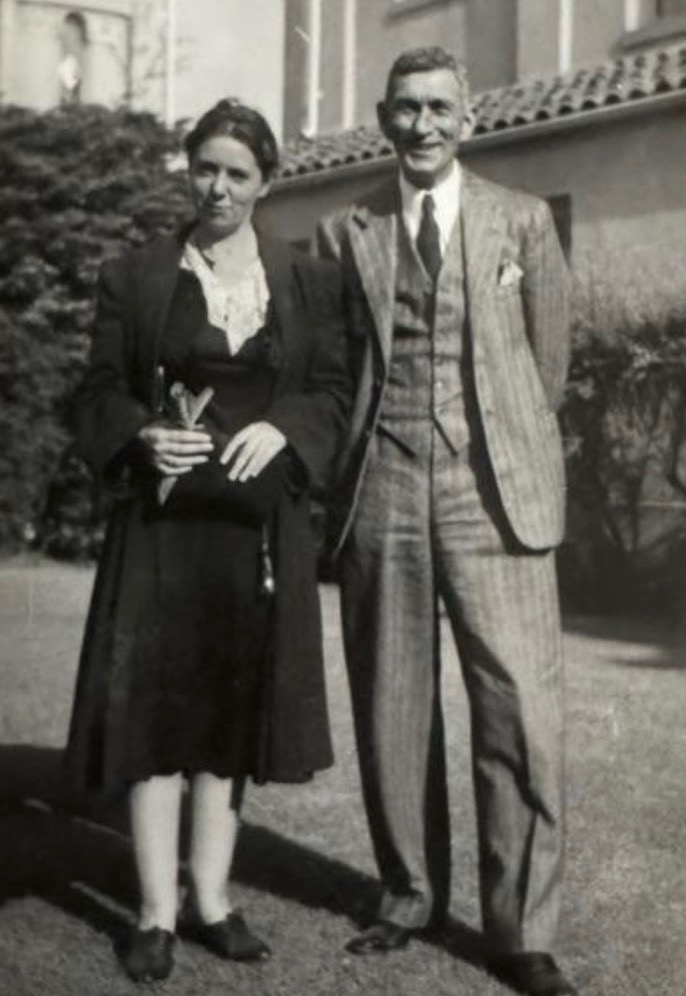
Mr. and Mrs. W.J. Fisk
By Elaine Koyama
Mrs. Fisk
Ivy Muriel Fisk (1901-1980)
In 2012 my mother, Emmy Kubo Koyama, died at the age of ninety-one. She left behind diaries dating from 1934-1942, at the time she was 13-21 years old. In those diaries, Mom referred to her Buddhist church choir director, Mrs. Muriel Fisk. Mom referred to attending choir practices and concerts during her middle and high school years, and Mrs. Fisk played an important part in her coming of age.
Mom was living in Guadalupe, California, a small town outside of Santa Maria when WW2 erupted. The West Coast Japanese communities were targeted by Executive Order 9066 and without any proof of wrongdoing, citizens and aliens alike were rounded up and imprisoned at Assembly Centers and later in ten concentration camps.
Initially the Japanese from Guadalupe were taken to Tulare, California, where the local fairgrounds and horse stables were converted to house approximately 5,000 inmates. My mother’s final diary entry mentioning Mrs. Fisk was June 20, 1942, written while she was at the Tulare Assembly Center:
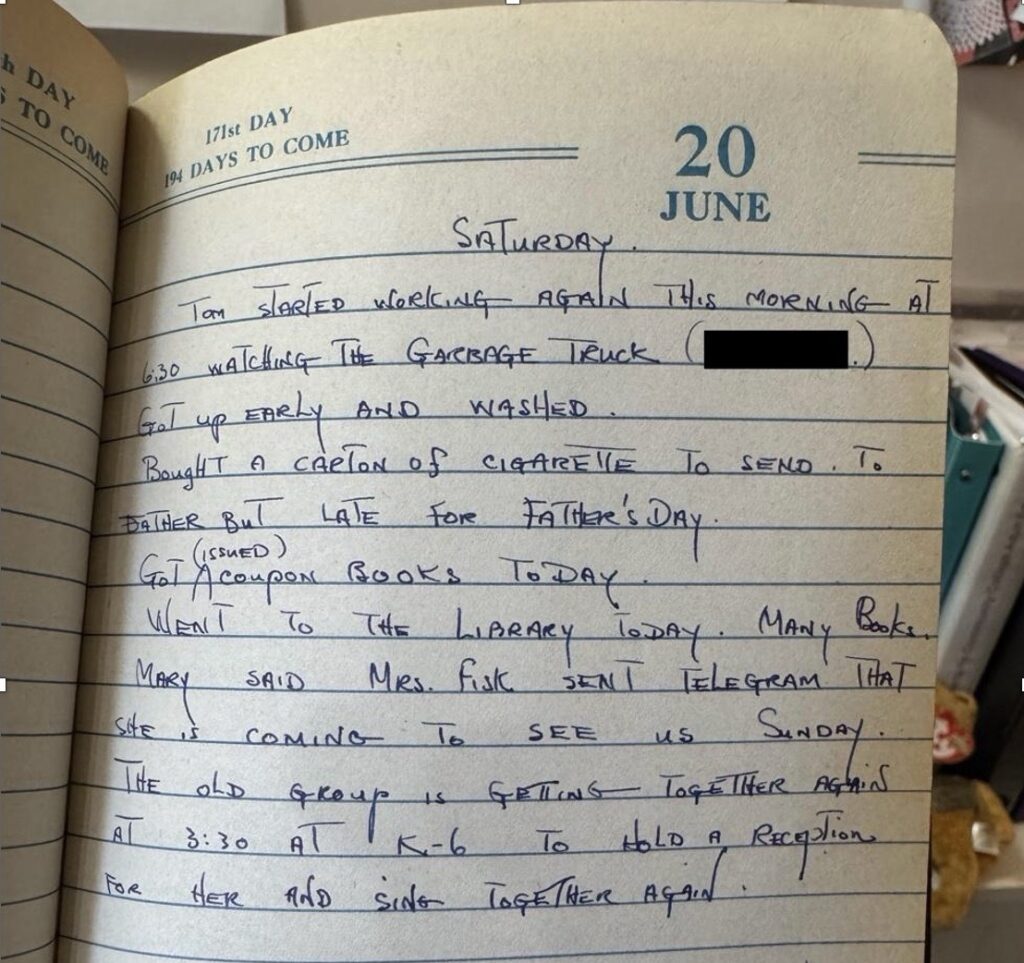
June 20, 1942
Saturday
…Mary said Mrs. Fisk sent telegram that she is coming to see us Sunday. The old group is getting together again at 3:30 at K-6 to hold a reception for her and sing together again.
It was from my mother’s actual diary entries and stories she had told me, I was inspired to include a creative piece about Mrs. Fisk in my book, Between Two Freedoms, a story about love and the incarceration of Japanese in America during WW2. I tried to capture my mother’s and Mrs. Fisk’s authentic voices and inner thoughts in dialogue and the details of their day, weaving her diary history and writing as an art. Here is that passage from the book, with Mom narrating:
“There was also a library with books, so I checked one out. Then I heard that Mrs. Fisk, our choir director from Guadalupe, was going to come and visit. The gang all got together at a reception for her, and Mrs. Fisk led us in some songs we all knew by heart, just like old times.
As she stood in front of us, she said, “I miss you girls so badly! I enjoyed our music, and I enjoyed working with all of you. You’ve all grown up, and you’ve all become such lovely women. I don’t understand the cruelty of our community.” She choked up. “I consider our time together in Guadalupe as some of the best years of my life.”
We sang our hearts out for another forty minutes, until she had to leave. She only had permission to visit until four o’clock, when she had to check out at the guard gate.
Later I heard from some of the gang that Mr. and Mrs. Fisk had been having a hard time back in Guadalupe because they’d been kind to us Japanese. They had been watching over some Japanese properties and had stored some belongings for Japanese friends. They said someone threw rocks at their windows—and Mrs. Fisk has always been nothing but kind.”
From Koyama, E. (2025). Between Two Freedoms, a story about love and the incarceration of Japanese in America during WW., Kubo Press Works, p.123.
Both Mr. and Mrs. Fisk visited Tulare Assembly Center.
The church choir wasn’t alone in benefiting from Mrs. Fisk’s musical gifts. Jane Imamura, a young, talented pianist and member of the Guadalupe Buddhist Church, was a piano student of Mrs. Fisk, and later, while at the Buddhist Church of Berkeley, received from Mrs. Fisk the gift of a grand piano which served the musical community of the church for years.
Mr. W.J. Fisk
William James Fisk (1879-1944)
While my book includes the reference to Mrs. Fisk, she was not alone in supporting the Japanese community in Guadalupe. Her husband figured prominently in their joint work.
The following excerpt, from the Guadalupe Buddhist Church website, recognized Mr. Fisk’s contribution to the community:
“…. With the outbreak of World War II on December 7, 1941, the FBI immediately interned most of the Issei (first generation Japanese) males from Guadalupe between the start of the war and February 18, 1942. Around March 1942, some of the remaining Issei and Nisei (second generation Japanese-Americans) decided to voluntarily evacuate to Central California. Then, after Executive Order 9066 led to the internment of all Japanese Americans, the remaining local Japanese families were sent to Poston Relocation Center in Arizona or the Tulare Assembly Center in California, and then ultimately to the Gila Relocation Center in Arizona.
During the absence of the membership, the Church buildings and facilities were left to the care of Mr. and Mrs. W.J. Fisk, while Mr. and Mrs. Regalado lived to the rear of the Church as caretakers. Mr. Fisk, a long time resident of Guadalupe, was a dedicated friend of the Japanese community. Mrs. Fisk was a piano teacher who taught many of the local girls and she was also the director of the Guadalupe Buddhist Girls Choir, which was formed in 1935 and performed on the local radio, piano recitals, Santa Maria High School, as well as singing gathas at Buddhist Services. In 1944, apparently because of the strong anti-Japanese sentiment and without any reason given, Mr. Fisk lost his employment at the Guadalupe plant of the Puritan Ice Co. of Santa Barbara. This led the Fisks to sell their home in August 1944 and leave the area, moving to New Mexico.”
From: Guadalupe Buddhist Church. (2026). Our history: Guadalupe Buddhist Church history (taken from the Centennial Anniversary Booklet). https://guadalupebuddhistchurch.org/our-history
Used under the Fair Use provisions of copyright law, for educational, non-commercial purposes only. All rights to the original content are held by their respective copyright owners.
My mother spoke so highly of Mrs. Fisk throughout my life, I am happy to contribute this story and pay homage to this woman and her husband, all these years later. Their friendship and support of the Guadalupe, California Japanese community will live on.
Images and photos courtesy of Elaine Koyama.
©2026 Elaine Koyama. All rights reserved.
Elaine Koyama is an author with a deep appreciation of her Japanese American heritage and a long, dynamic career in American business. Born and raised on a farm in eastern Montana, Koyama is a third-generation Sansei Japanese American. She went on to graduate from Stanford University and spent 20 years working for Cargill, a global agribusiness corporation before transitioning to a 20 year career as a Technology consultant. Koyama now focuses on writing, teaching and enjoying life in Santa Fe, New Mexico.
Elaine Koyama Writes! Between Two Freedoms a Story about Love and the Incarceration of Japanese in America during World War 2. Award Winning author of LET ME IN a Japanese American Woman Crashes the Corporate Club.
Follow me at: https://elainekoyama.com
612-940-5002