“After the ACLU on the West Coast decided that they could not support
any challenge to an order by the President of the United States,
they asked the American Friends Service Committee (AFSC)
in Philadelphia to recommend someone to argue the Hirabayashi case
in the Supreme Court.”
“The parallels to today are uncanny.”
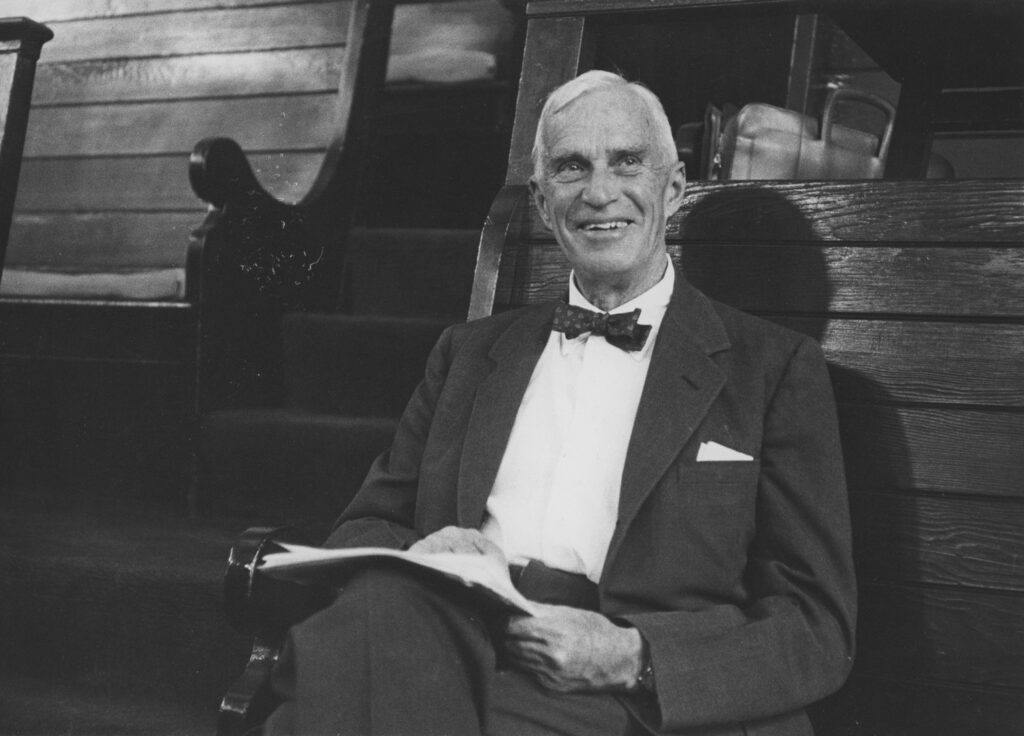
Harold Evans
(1886-1977)
Lawyer for Hirabayashi v. United States, 320 US 81 (1943)
Quaker, American Friends Service Committee (AFSC)
By Kathryn (Kitty) Mizuno
As a child what I thought I was learning from my grandfather was good manners, how to swim, row and sail, play scrabble, bits and pieces of poetry that he had memorized and the like. In recent years, after learning more about his life of Quaker service I am learning that we do not always live to see the fruits of our faithfulness to what we are called to do, but that truth can prevail in the end. Over eighty-two years ago, on May 10 and 11, 1943, two lawyers selected by the American Civil Liberties Union (ACLU), Frank Walters and my grandfather, Harold Evans, represented Gordon Hirabayashi before the Supreme Court of the United States. Mr. Hirabayashi had refused to obey the curfew and mass incarceration orders to people of Japanese ancestry. The case had been rushed to the Supreme Court so quickly that Walters and Evans met for the first time only half an hour before they stood before the court to present their arguments. Had the case been allowed to be considered more deliberately, carefully, and slowly, reason might have triumphed over war hysteria and Hirabayashi might not have been found guilty.
As a lawyer, my grandfather was a deeply principled Quaker who followed what he understood to be leadings from God. This led him to do things that would not appear to be “common sense”. Harold Evans was asked to represent Gordon Hirabayashi in the Supreme Court because anti-Japanese sentiment was so prevalent after the bombing of Pearl Harbor that others were reluctant to take on such a task. Initially in 1942, Washington State Senator Mary Farquharson had suggested that Hirabayashi make himself a test case. After the ACLU on the West Coast decided that they could not support any challenge to an order by the President of the United States, they asked the American Friends Service Committee (AFSC) in Philadelphia to recommend someone to argue the Hirabayashi case in the Supreme Court. It seems that it was thought that anti-Japanese sentiment would not be as strong on the East Coast, and that during the time that it took for the case to reach the Supreme Court the anti-Japanese sentiment would have waned nationwide. My grandfather was asked to work with Frank Walters to prepare arguments in the case. They did not expect that the case would be rushed to the Supreme Court so quickly, so he had only a month to prepare.
Hirabayashi himself says in the book based on his writings, A Principled Stand: The Story of Hirabayashi v. United States, that President Roosevelt had pressure put on Justice Frank Murphy not to dissent, making it a unanimous Supreme Court decision. The case was lost.
So, it might be said that my grandfather’s efforts to exonerate Hirabayashi were a failure. However, 45 years later, in 1987, the case against Hirabayashi was vacated, thanks to the discovery of government records supporting Hirabayashi’s case that had been suppressed in 1943 when the case was heard. Kathryn Bannai was lead counsel in this coram nobis case that nullified the judgment that convicted Hirabayashi.
Like Hirabayashi, my grandfather, by representing the young Japanese-American Quaker student, also took a stance of integrity, equality, service and fairness based on his beliefs. In the long run these won out. In 1988, a year after the Hirabayashi case was vacated, President Reagan issued an apology to those of Japanese descent who had endured incarceration during the war, and some reparations were paid to those still living. Unfortunately, Harold Evans had already passed away a decade before and never knew this.
Harold Evans worked with the American Friends Service Committee (AFSC) in various capacities for most of his life, serving on its Board of Directors since its inception in 1917, going to Germany in 1920 with the post-World War I child feeding program, and much later serving as AFSC Chairman until 1963. In 1948, he was chosen by the United Nations to be mayor of Jerusalem in a time of turmoil. The New York Times described this position as one of the most unwanted jobs in the world. After going to Jerusalem to negotiate with the hostile parties there, he ended up resigning his post, because his Quaker beliefs could not allow him to accept military protection.
I knew “Ganfaddy” as a kind, but strict patriarch who sat at the head of the table and carved the turkey. He would read aloud to us after dinner until he was laughing too hard to continue and had to ask us to take over the reading. Although I don’t remember hearing him talk about his professional or social service activities, after learning more about his life of service I am learning that we do not always live to see the fruits of our faithfulness to what we are called to do, but that truth can prevail in the end.
The parallels to today are uncanny. Along with Aiko Herzig-Yoshinaga, an archival researcher, lawyer Peter Irons uncovered wartime governmental suppression of evidence during the Hirabayashi, Yasui and Korematsu Supreme Court cases that led to the mass removal and incarceration of Japanese Americans. Irons entitled his 2006 book, War Powers: How the Imperial Presidency Hijacked the Constitution.
My conclusion is that the principled Quaker stands taken by my grandfather were shown to be solid decades later.
© 2026, Kathryn Mizuno
Kathryn (Kitty) Mizuno was raised on a Quaker family farm in Cinnaminson, New Jersey. After graduating from college in 1967, she was sent to Japan to teach English in the Friends Girls School in Tokyo, Japan. After moving back to the New Jersey farm with her husband and two children more than 20 years later, she spent the next two decades there teaching English and Japanese. After her retirement her family has settled in Watsonville, California, and become active in the historic Japanese American community there.