“The ultimate goal of cultural unity can best be achieved by accepting diversity for the present.”
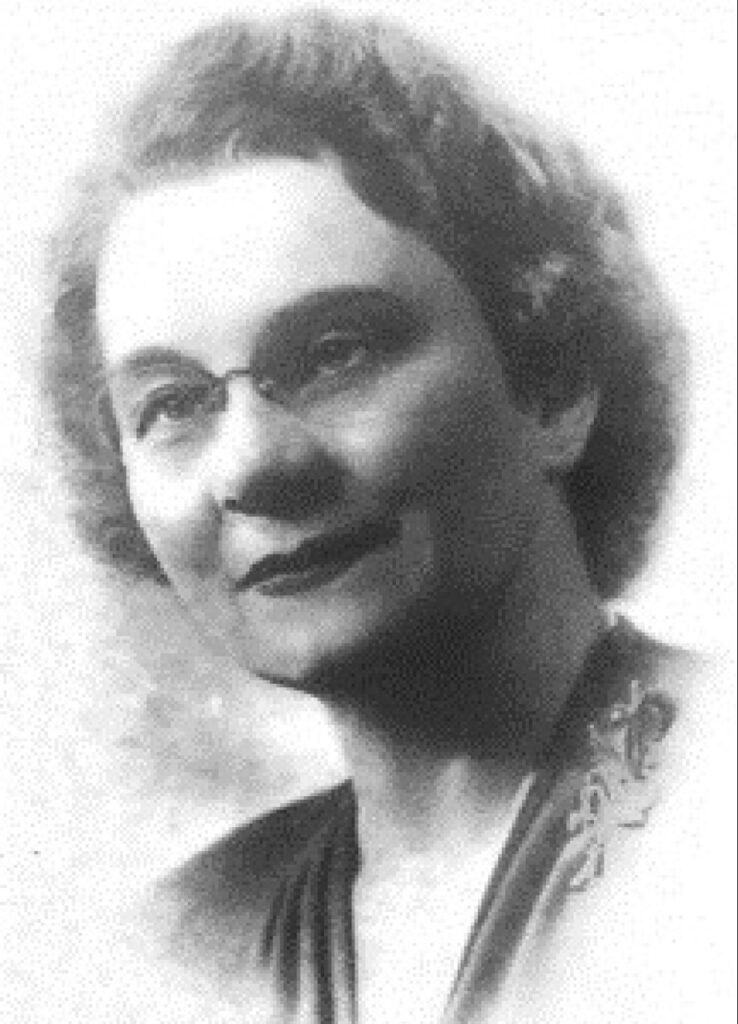
Alice Malinda Lilliequist Sickels
(1892-1965)
St. Paul Resettlement Committee,
International Institute in St. Paul, Minnesota, MN
International Institute, Detroit, MI
By Krista Finstad Hanson
Independent Historian
Alice Malinda Lilliequist Sickels was the third Executive Secretary of the International Institute in St. Paul, Minnesota from 1931 until 1944.
The St. Paul Resettlement Committee was started by the International Institute in St. Paul in October of 1942 to assist with the relocation of Japanese Americans from the concentration camps established by the US government’s War Relocation Authority (WRA) in March of 1942. It was one of thirty-five such committees that operated across the country during World War II. The SPRC was initially formed by the International Institute of St. Paul under the leadership of Alice Sickels, the Executive Secretary, and Bess L. Beebe, the Board of Directors president.
From the October 5, 1942 “Report to the Board of Directors of the International Institute from the Executive Secretary” {given by Alice Sickels} she shared news gathered from attending the National Convention in New York City, from September 26-27, 1942.
Alice Sickels wrote in the report: “The Japanese Americans are moving fast into War Relocation Camps and they are now under the control of the War Relocation Authority of which Thomas V. Holland of Washington D.C. is the director. It is the wish of the Federal government that loyal American citizens leave the camps and establish themselves in places where they can be accepted and self-supporting – preferably in the middle areas of the United States. This can only be affected on a case by case basis. Individuals must find places to work and live and then they will be released.”
Sickels later wrote, “It was agreed that we are not obligated …but that help in the resettlement of American citizen Japanese is a War Service which our government is asking of everyone who can help. In these days every person and every agency has a primary obligation to do the particular War Service for which they are best fitted; therefore, the International Institute does have an obligation both of service and leadership relative to this particular emergency and should help in the resettlement of Japanese Americans.” (SPRC papers, Minnesota Historical Society, folder 7)
This organization quickly became a community-wide organization and was reorganized in March of 1945 and separated from direct leadership of the International Institute of St. Paul in order to engage in legal contracts and get funding from the Council of Social Agencies and the Community Chest. From August of 1945 to August of 1948 the SPRC operated the St. Paul Resettlement Hostel at 191 W. Kellogg – next door to the Institute at 183 W. Kellogg Boulevard.
Alice Sickels left her position at the International Institute in St. Paul in September of 1944 with a leave of absence to write a book. Alice Sickels wrote an engaging history of the International Institute in St. Paul and the Festival of Nations in her book, Around the World in St. Paul (1945, University of Minnesota Press.).
From Chapter 7 of Alice Sickels’s book Around the World In St. Paul (1945, University of Minnesota Press), titled “Why Are You Doing This?”, Sickels wrote about the situations that brought Japanese Americans to Minnesota during World War II. She wrote that “Assimilation is a 2-way street.” She gave specific examples of Nisei she had helped and wrote “Second-generation Americans want terribly to be accepted…” She wrote that “The ultimate goal of cultural unity can best be achieved by accepting diversity for the present.” In this chapter, Sickels shared information and stories about discrimination faced by Nisei in housing and jobs. She detailed how International Institute social workers helped Nisei moving to St. Paul. She wrote that “A firsthand pleasant experience with a person of Japanese background kills the stereotype. It rarely dies any other way.”
In Minnesota there was another resettlement committee and hostel operating in Minneapolis. There were smaller efforts taking place around the state in Duluth and Rochester, for example. Exact numbers aren’t known but it is estimated that 3,000 Japanese Americans resettled to Minnesota during World War II assisted in part by the fact the Military Intelligence Service Language School training Nisei soldiers operated at Camp Savage and then Fort Snelling in Minnesota.
As of September 8, 1944, Sickels was in Detroit and became the director of the International Institute in Detroit, Michigan, where she assisted with its separation from the YWCA and the creation of a separate agency, as she did for St. Paul, Minnesota and served until 1959. She died December 18, 1965 in Wilmington, New Castle, Delaware at age 75. She is buried along with her husband and parents in Vasa Lutheran Cemetery in Vasa, Goodhue County, Minnesota.
In the words of Alice Sickels, “Liberty, justice, and amity can survive only among comparatively secure people.” These words still ring true.
© 2026 Krista Finstad Hanson. All rights reserved.
Krista Finstad Hanson is a teacher, writer, and historian. She holds a BA in English, an MEd in secondary English education, and two teaching licenses. She is the author of Minnesota Open House (Minnesota Historical Society Press, 2007), Great Barrier Reef (Creative Company, 2005) and Wisconsin Historic Houses & Living History Museums (Prairie Oak Press, 2000). An active freelance writer and author of more than 300 freelance articles, she has been a two-time grant recipient from the Minnesota Historical Society and a Gale Library Research Fellow at the Minnesota Historical Society in 2017-2018. She is a member of the Twin Cities chapter of the Japanese American Citizens League Education committee. She has assisted in two museum exhibits telling the story of the Japanese and Japanese American community in Minnesota.
ODG Post-story Note: With longtime and current experience with Minnesota immigration issues, Krista Finstad Hanson contacted the ODG Project about Japanese American settlement in Minnesota after WWII. The story above is a short introduction to Alice Sickels and the work of the International Institutes from Krista’s earlier research and publications. Through the link to the article at right, and others following the article, we urge you to read Krista’s articles. They flesh out the background of the WWII era in which the International Institute in St. Paul created the a committee to help the Japanese Americans settle there from the incarceration camps. The links also provide a full reference list for information in the Alice Sickels story above.
Hanson, K. F. (2018). The St Paul Resettlement Committee. Minnesota Historical Society. https://www.mnhs.org/mnopedia/search/index/group/st-paul-resettlement-committee
Hanson, K. F. (2019, Spring). The centennial of the International Institute of Minnesota. Ramsey County History, 54(1),1–13. https://rchs.com/wp-content/uploads/2019/05/RCHS_Spring-2019_Hanson.pdf
The list of Krista’s articles on the Minnesota Historical Society website includes a link to an article about Ruth Tanbara, a Japanese American who worked for the International Institute: website” https://www.mnhs.org/mnopedia/search/index/author/krista-finstad-hanson?page=1.
Krista is an authority on the history of the International Institute of Minnesota, which figures prominently in today’s events, as the nation looks to Minnesota as a leader in community support and policies for its immigrant populations.
Links to two International Institutes active today:
Intl. Institute of Minnesota: https://iimn.org/about-us/
Intl. Institute of St. Louis: https://www.iistl.org/

The same three words. In her 1945 book, Around the World in St Paul, Alice Sickels wrote of diversity, equity and inclusion – the same three words which came to be adopted in US government policy under the Office of Diversity and Inclusion, which was eventually defunded with its website officially “archived” on Jan. 20, 2025 under new Administration policy. The former website was https://2021-2025.state.gov/bureaus-offices/secretary-of-state/office-of-diversity-and-inclusion/
The ODG Project is sincerely grateful to those individuals and organizations whose missions included facilitating and easing the resettlement of Japanese Americans in the WWII era to find housing, employment, and to advance their opportunities. At the same time, we recognize that the zeal with which the WRA (War Relocation Authority) encouraged Japanese Americans to leave the incarceration sites for points east during the war, without permitting them to return to the West Coast and without “too many” Japanese congregating in one area. This has been discussed as a form of forced assimilation into unfamiliar communities and an intended loss of cultural identity after the forced removal from their West Coast homes, farms and businesses.