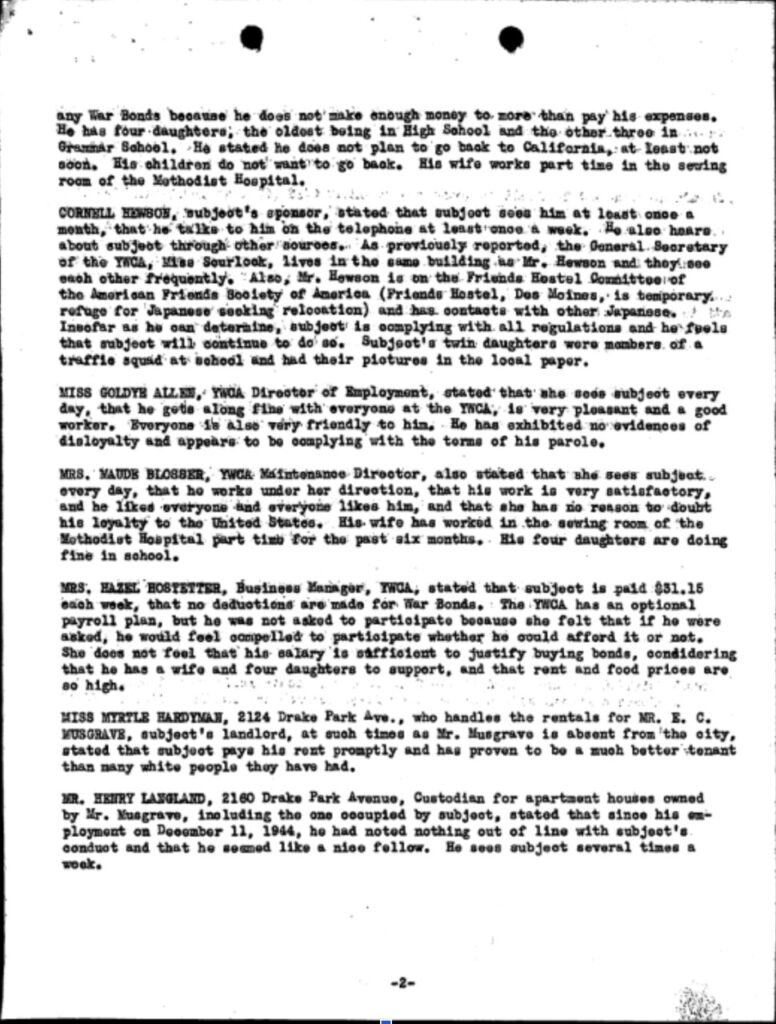
“A letter written by Cornell Hewson to the Alien Enemy Parole Board on July 13, 1945 contained in Noboru’s FBI file shows the support he gave Noboru and the family.”
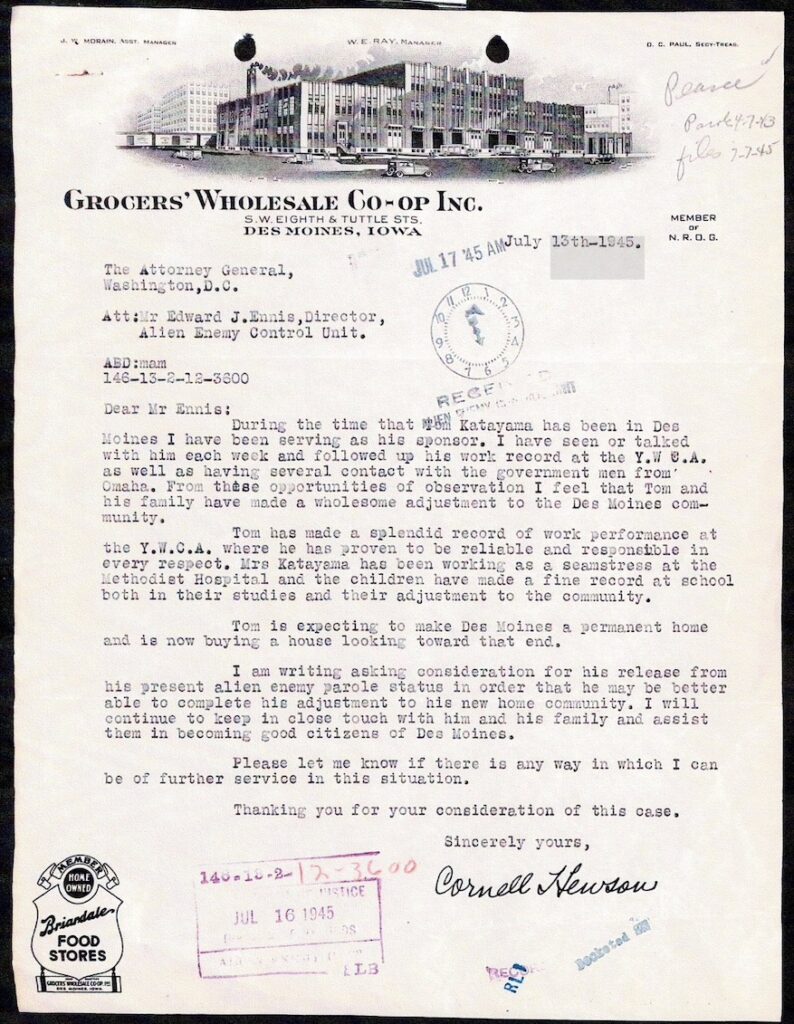
July 1945 letter from Cornell Hewson requesting that Noburu Katayama be released from parole status as an enemy alien. Enlarged for readability at end of story.
Cornell Hewson
American Friends Service Committee of Des Moines, Iowa, and
Chairman of the community-wide
Des Moines Citizens Relocation Committee
By Ellen Mayhew, granddaughter of
Noburu and Yaye Katayama
My mother’s family received help from the Quakers to resettle from the Jerome War Relocation Center in Arkansas to Des Moines, Iowa in April, 1944. At that time, the West Coast was still off-limits for the Japanese Americans, and the family had no ties to other parts of the country. Without the sponsorship by Cornell Hewson, a Quaker of Des Moines, Iowa, it is unlikely that they could have left Jerome for months.
Before World War II, the Katayama family lived in Long Beach, California where my grandparents Noboru and Yaye owned two produce stores. Their four daughters Yuriko, Miyeko, and twins Itoko and Setsuko were ages 12, 10, and 8 at the time of Pearl Harbor. In February 1942, Noboru was arrested by the FBI as an enemy alien due to his involvement with the local chapter of the Japanese Association and the Japanese language school held on Saturdays at the Long Beach Presbyterian Church. He was imprisoned at Lordsburg, New Mexico and other locations while the rest of the family was sent first to Santa Anita Assembly Center and then to Jerome War Relocation Camp. After 17 months of separation from his wife and daughters, Noboru was permitted to join his incarcerated family at Jerome in July 1943.
Once he was reunited with the family, Noboru immediately started looking for a way for them to leave camp. By April 4, 1944 the family had secured arrangements to leave Jerome and resettle in Des Moines, Iowa through a Quaker sponsor named Cornell Hewson. Temporary lodging was provided at the American Friends Service Committee hostel, and Noboru was given employment as a custodian at the local YWCA. Cornell was on the Friends Hostel Committee of the American Friends Society of America, and as the family’s sponsor and parole reference for Noboru, he met with Noboru monthly and talked on the phone at least once a week.
A letter written by Cornell Hewson to the Alien Enemy Parole Board on July 13, 1945 contained in Noboru’s FBI file shows the support he gave the Katayama family. He was especially anxious for Noboru’s release from parole in order that he could have better work opportunities to support the family.
Overall, the family seemed to thrive in Des Moines. The memories that my mother and aunts shared indicate that the Des Moines residents accepted them into the community. Yaye found employment as a seamstress in the sewing room at the Methodist Hospital and at a dry cleaners. When they arrived in April 1944, Yuriko entered ninth grade, Miyeko seventh grade, and Itoko and Setsuko fifth grade, where they did well in school and made many friends. Itoko and Setsuko were on the traffic squad at school and got their pictures in the local newspaper. Yuriko graduated from high school in 1947 and attended Drake University in town.
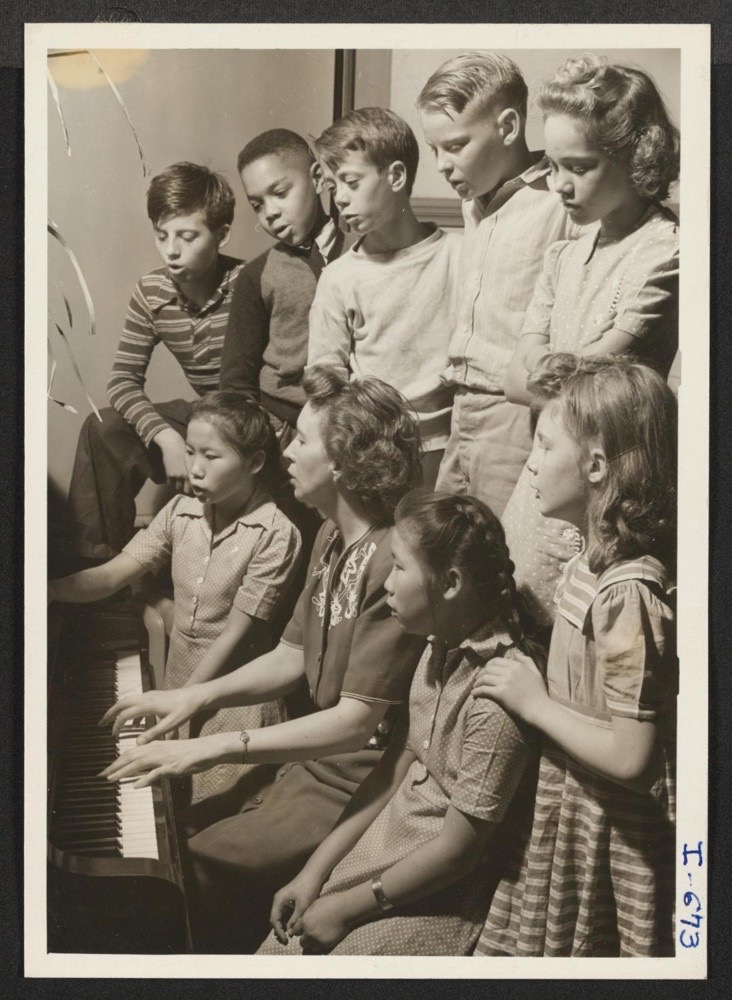
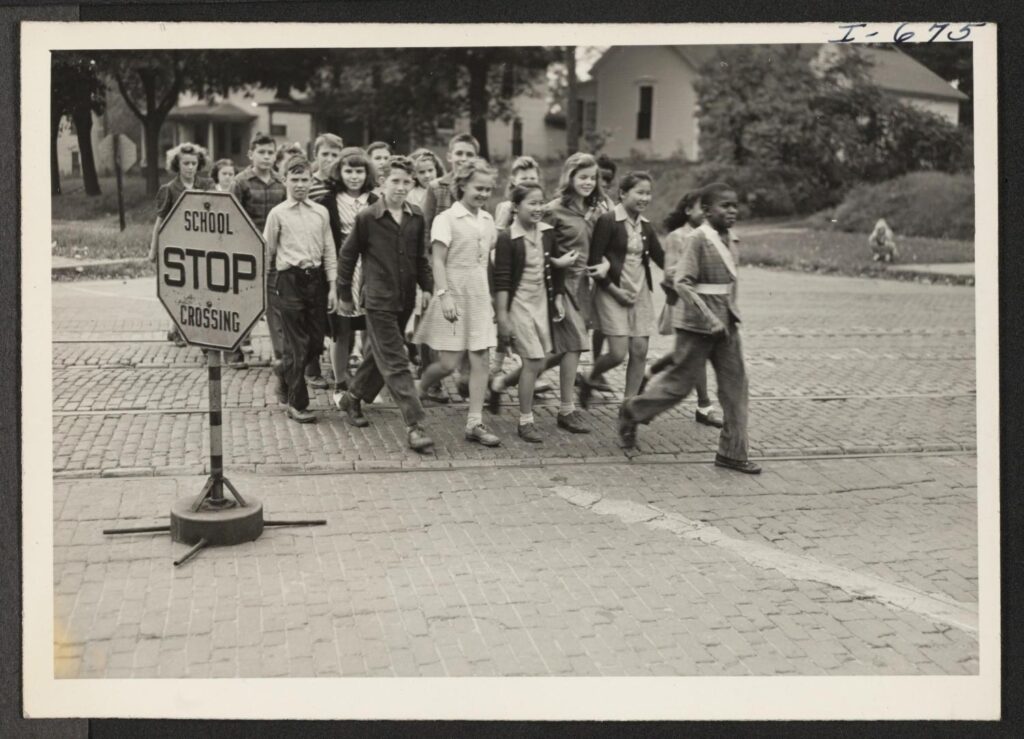
Photo on left: “The Katayama twins, Itoko and Setsuko, in the 6B class at the Grant School, are shown with other pupils of Miss Lorraine Lange, their teacher, in a fun sing, with Miss Lange at the piano…” Photo on right: “… Itoko and Setsuko… are shown as they go home for their noon lunch, being directed across the street along with other pupils by the young safety student.” From: War Relocation Authority photographs: Japanese-American evacuation and resettlement, BANC PIC 1967.014 V.51 FI-675–PIC, date Sep 1944, The Bancroft Library, University of California, Berkeley. Photos in the public domain.
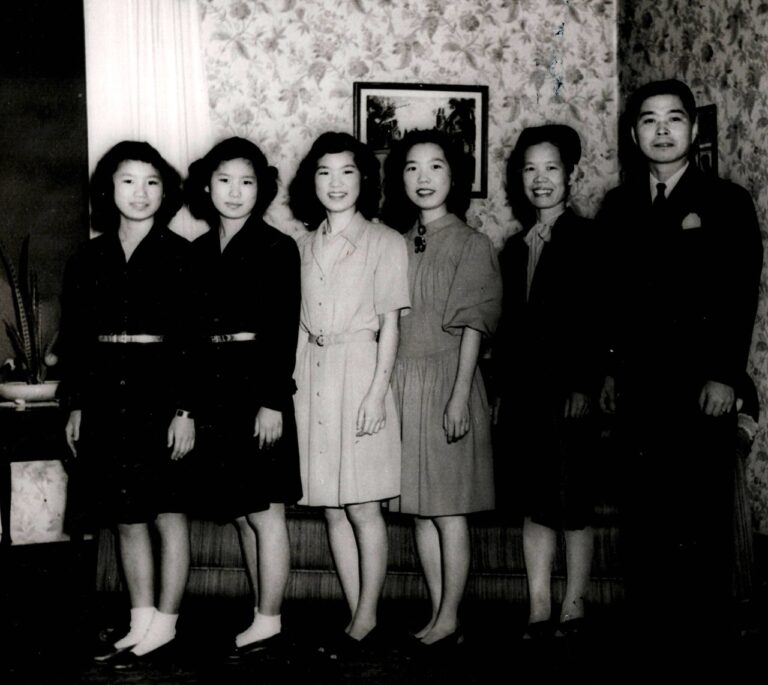
Katayama family, Des Moines, Feb. 1947.
L-R: Itoko, Setsuko, Miyeko, Yuriko, Yaye, and Noboru.
Photo courtesy of Ellen Mayhew.
After five years in Des Moines, the family moved to Chicago, where Noboru hoped that his daughters would marry within its larger Japanese American community.
All photos and images courtesy of Ellen Mayhew.
©2026, Ellen Mayhew
Ellen Mayhew is the elder daughter of Harry and Setsuko (Katayama) Nagaoka and was born and raised in Chicago, Illinois. After residing near Dayton, Ohio for forty years, she recently moved with her husband to East Lansing, Michigan to be near their two young granddaughters. Now she is enjoying new roles of grandmother and unofficial family historian.
ODG Additional notes: Interesting information about the Hewson Family
Cornell Hewson eventually became Chairman of the Des Moines Citizens’ Relocation Committee, also referred to as The Des Moines Relocation Committee in other sources, and described as “ a coalition of local churches and community members.” https://hojishinbun.hoover.org/?a=d&d=ytn19450530-01.1.4&e=——-en-10–1–img———
https://encyclopedia.densho.org/Friends_Hostel,_Des_Moines/
What did he do for a living? During WWII, Cornell Hewson was in the Sales Promotion Department of “Grocers’ Wholesale Co-Op, Inc.” According to Wikipedia, “It is possible that it was the first statewide organization of this kind in the country. The cooperative allowed independent grocers to compete against chain stores and survive wholesale grocers’ surcharges.” Its operations grew into four States, and was in existence until 1985. https://en.wikipedia.org/wiki/Grocers_Wholesale_Company_Building
What about Mrs. Hewson and any children? Were they involved in similar activities?
Estelle Hewson had an early hand in the resettlement of Nazi Germany refugees to the Des Moines area, beginning in 1939. She was listed on the equipment committee of the “progressive branch of the Friends” to convert an old boarding school, Scattergood, into a hostel for refugees, a large percentage being Jewish, in direct response to the Nov. 1938 pogrom, Kristallnacht. Cornell and Estelle’s daughter, Camilla Hewson volunteered at Scattergood Hostel: “As an adult looking back, Camilla (Hewson) Flinterman wrote that the 14 months she spent as a teenage volunteer at the hostel were “eye-opening, mind-expanding and enriching.” She became a social worker in Ohio.
Pick committees to direct Scattergood. Special to the Gazette.(1939, Feb.27) West Branch, The Gazette from Cedar Rapids, Iowa, 4. https://www.newspapers.com/newspage/547391331/ (Requires subscription).
Far from Hitler: Scattergood Hostel/WWII-Era refugee exhibit. Traces. https://usgerrelations.traces.org/scattergood.exhibit.html
How was the AFSC Hostel funded?
“The difference between the cost of this [hostel] service and the dollar a day which each guest pays is met by voluntary contributions from friends of this work who want to have a part in expressing their friendship to this minority group.”
“You can help us in three ways, first by interesting yourself and your friends in the problem of. resettlement, second by making welcome any evacuees who may come to your neighborhood, and third by contributing towards the cost of maintaining the Hostel. We hope that you will find it possible to help us in all three of these ways…”
Excerpt from a Letter from the American Friends Service Committee, Des Moines Hostel and Office, Des Moines, IA, to “Friends” (Nov. 6, 1943). American Friends Service Committee. https://afsc.org/sites/default/files/documents/1941%20Japanese%20Resettlement%20in%20Des%20Moines.pdf