“Dad must have found work there after internment. Joyce (my sister) and I sat on their kitchen countertop watching Mrs. Parrish roll her cookie dough.
She always baked cookies for us, bless her soul.”
Bill Parrish and family
Friends of the young Mitsuru Suko,
who re-started farming upon his return to Lindsay, CA
By Greg Suko
Arigatō to Bill Parrish and his family for not discriminating against Japanese Americans for their race and culture at a time when our nation was at war with Imperial Japan. Within this fragile period, 22-year-old Mitsuru Suko, and his Issei father, Katsuhei Suko, had been farming tomatoes in Lindsay, CA. The 1940 US Census shows that their house and farm was owned, not rented, and shows Mitsuru as head of household, which was necessary because Issei were not allowed to own property.
At the start of WWII, Katsuhei was picked up in the early round-up of Issei men, leaving Mitsuru by himself on the farm. Later in 1942, Mitsuru was sent to Poston incarceration center in Arizona. There, he met Mariko, they married, and two sons, Yoshi and Kaz, were born in Poston.
After the war, Mitsuru returned to the Lindsay area with a young family of four, but they were not able to return to the land that he and his father had farmed before the war. From limited research using resources online with the National Archives and Records Administration and Densho, I found the location where my grandfather’s father; Katsuhei, was picked up by the FBI in Lindsay, CA. I also found the location of where they originally farmed, and the bank showed the operator change over to a farm operator other than my grandfather — Location of farm: P.O. Box 723, Lindsay, CA corner 5th & O, four miles south of Lindsay. Name of new operator: H.W. Parker. The details of what happened to the farm at this address are still to be known.
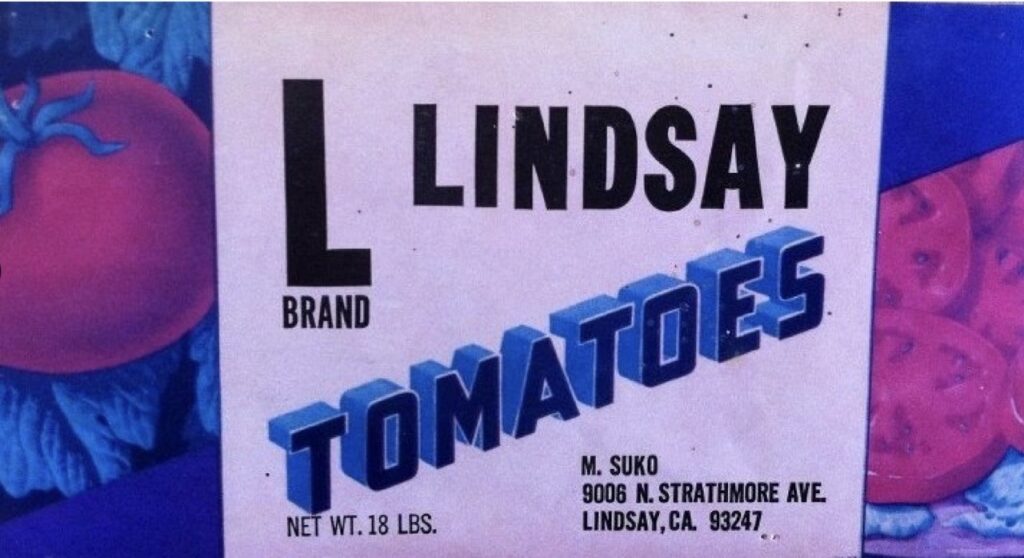
With hard work and the friendship of Bill Parrish to help him start over, Mitsuru eventually re-established himself again in Lindsay, in another location, where he would remain tilling the soil and growing tomatoes for another thirty plus years.
My Uncle Kaz has memories of Bill Parrish on a farm in nearby Earlimart after the war. “Highway 99 passes through a small farming town named Earlimart that is located between Tulare and Delano, CA.” My Uncle Kaz continues, “Bill Parrish had his farm there. Dad [Mitsuru] must have found work there after internment. Joyce [sister born after Poston] and I sat on their kitchen countertop watching Mrs. Parrish roll her cookie dough. She always baked cookies for us, bless her soul. There was another Earlimart family, the Johnsons, who were also friends of Dad.” My father, Yoshi, also remembers Earlimart as a child. He recalled speaking only Japanese at an early age and then having to catch up learning to speak, read and write English just to enter elementary school.
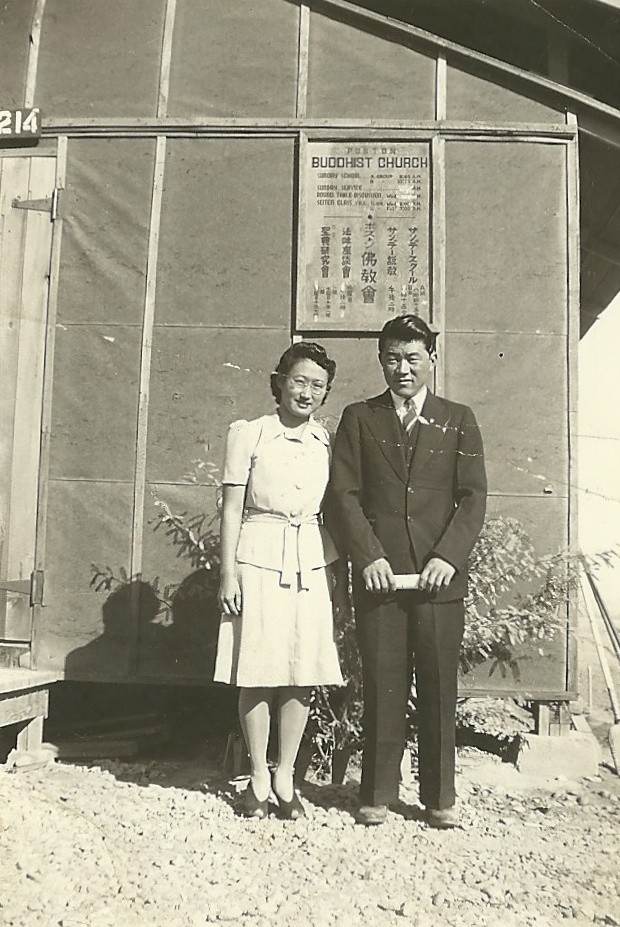
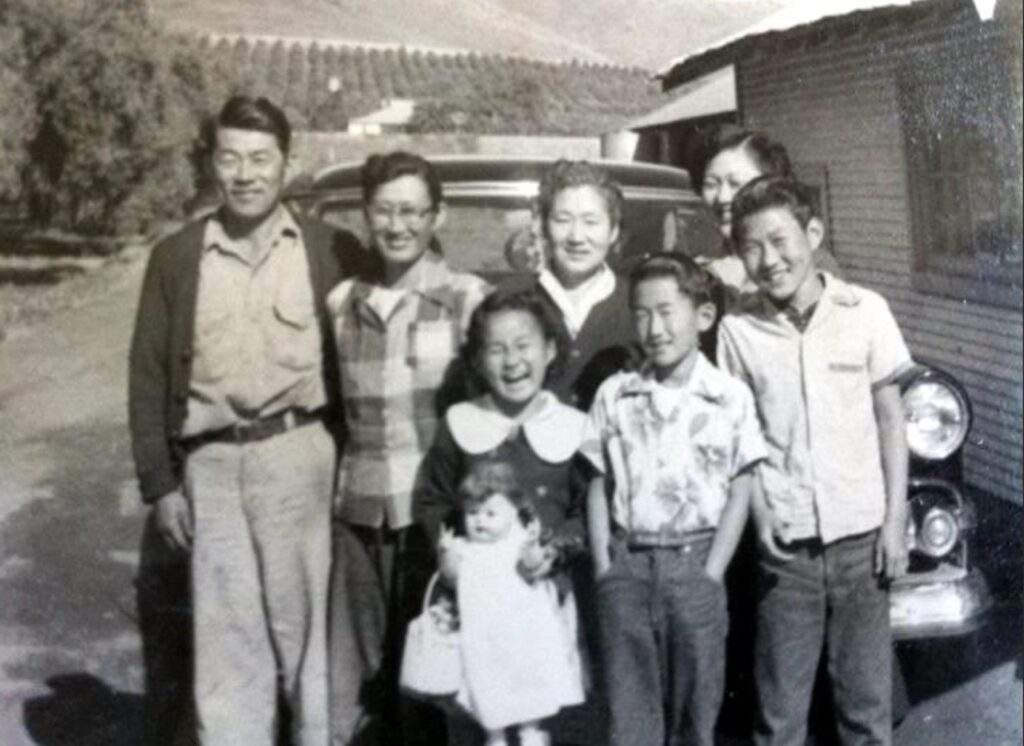
From incarceration to starting anew, with gratitude for the friendship of Bill Parrish.
Photo at left: Mari and Mitsuru, married in Poston.
Photo at right:: Mitsuru, Mari and Joyce, Kaz and Yoshi, two unidentified women in Lindsay.
Exactly when Mitsuru moved to acquire his second, postwar home in Lindsay I am not sure, but from my childhood I can remember the ranch-style home carved out from an olive orchard. My Uncle shared with me that the living room used to be where an abandoned pump house once operated, and that a wooden structure my grandfather Mitsuru built was the family ofuro. I remember riding bicycles with my brother all the way up a dirt road to the irrigation canal (Friant-Kern Canal), as if it was yesterday and not nearly fifty years ago. On the other side of the canal, not sure what direction or how many miles, was the site where my grandfather farmed tomatoes. I just know it was close because we could go from the house to the farm in what seemed to be ten minutes. My job was lining wooden boxes with purple corrugated cardboard. Early in the season, I would drag boxes of white caps that insulated the young tomato plants. As we went up and down each row, my grandfather would place a cap over each individual plant and secure it in place with a metal frame, scraping soil at the base of the frame, and move on to the next plant. I was too young to pick, pack or sort tomatoes or operate any equipment.
With Gratitude,
Gregory Suko
Oldest Grandchild of Mitsuru and Mariko Suko
© 2026, Greg Suko
Greg Suko is a Yonsei from Clovis, California. He has made Albuquerque his “adopted” home since 2014 when he relocated from the San Francisco Bay Area for a new job with the federal government and a new start in life. Greg remarried in 2016, to Amy Chvatal in Santa Fe, NM. His daughter, Madison, still lives in the Bay Area. Greg currently works for the State of New Mexico’s Division of Vocational Rehabilitation. Greg and his wife Amy are recent members of JACL.
ODG Post-story Note:
Although Mitsuru Suko was able to start anew in farming after WWII, what exactly occurred to the land he had prior to his grandfather’s incarceration at Lordsburg and Poston remained unknown to Greg at the time of this writing. With this mystery, we became aware of the Nikkei Farm History website: https://kanshahistory.org/. “The Kansha History Project documents and celebrates the contributions, skills, and accomplishments of Nikkei (Japanese American) farmers prior to World War II—a legacy which continues to this day. Many had invested their entire savings as well as their labor, skills, hopes, and dreams, into these farms, which they were forced to give up. The losses in crops, structures, land, and housing were recorded by federal field agents. These records are a window into the family and community life of thousands of Japanese Americans. Over 200 volunteers, mostly Nikkei farmer descendants have transcribed over 6,000 records, making them searchable to descendants.”