“… when the president of the college, Franklin Winslow Johnson, received his application, they held an assembly with the entire student body and told them about how and why the Japanese Americans were being unjustly incarcerated and asked them if they would be willing to accept and welcome Japanese American students.”
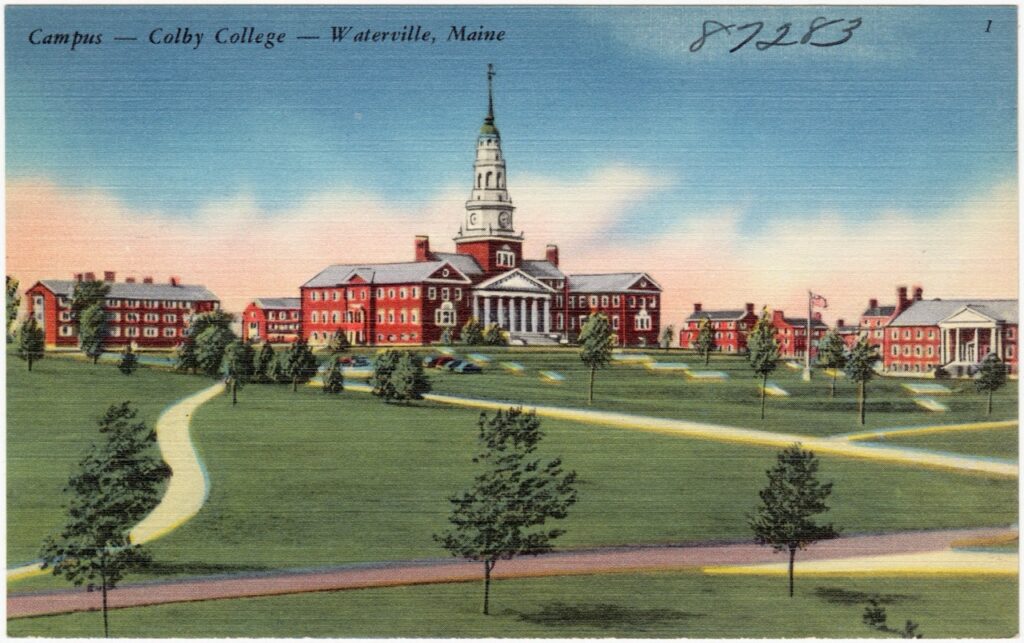
Colby College campus, Waterville, ME. Tichnor Bros, Publisher – Boston Public Library;
Tichnor Brothers collection #87283, in public domain.
Kindness at Colby College
By Gerri Igarashi Yoshida
My father, Peter Hiroshi Igarashi, got out of camp in about six months. He and his family were incarcerated in Tule Lake. My Dad said because Quakers were conscientious objectors and refused military service on religious grounds, many of them were sent or chose to serve in the internment camps instead. They helped many college students find colleges away from the West coast that were willing to accept Japanese American students. My Dad went to Colby College in Maine which was founded by Baptists with a commitment to social justice, and whose students had an early involvement in the anti-slavery movement. I often imagine my father who was born and grew up in Sacramento arriving in Maine without a winter coat and never having seen snow.
My father loved Colby. He said when the president of the college, Franklin Winslow Johnson, received his application, they held an assembly with the entire student body and told them about how and why the Japanese Americans were being unjustly incarcerated and asked them if they would be willing to accept and welcome Japanese American students. They must have voted yes, because my father was accepted. Even in his later years, my father acknowledged that he received an excellent education at Colby. They taught him how to think critically and analytically. He said that their teaching style and methods influenced and impacted him as a professor of Greek and New Testament at the seminary at Virginia Union University, an historically black university in Richmond, Virginia, where he met the Rev. Dr. Martin Luther King, and at the Episcopal seminary at the University of the South in Sewanee, Tennessee which at that time was all-white and men-only.
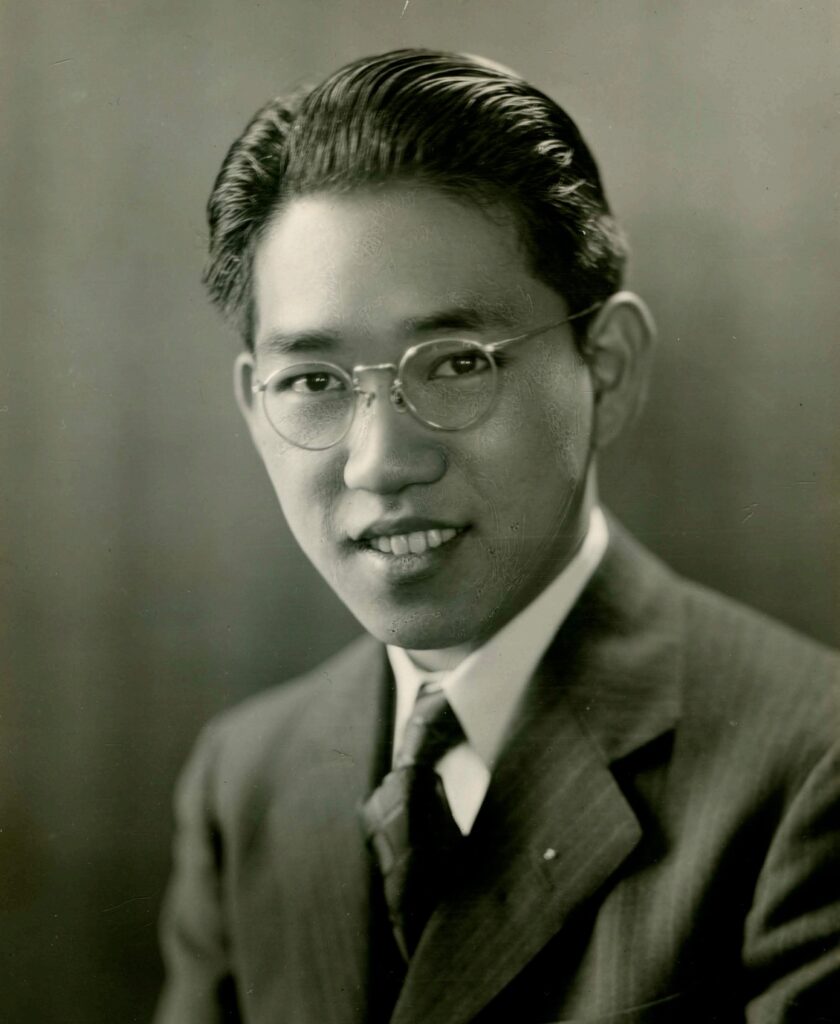
Peter Igarashi. “Courtesy of Special Collections and Archives,
Colby College Libraries, Waterville, ME.”
Outside of the classroom my father was shown kindness, acceptance, generosity and hospitality. His roommate invited him to his home in Portland for Thanksgiving and took him sightseeing. As soon as my father got back to campus, Ernest C. Marriner, the Dean of Men, called him into his office. “Peter, were you in Portland last weekend?” My father acknowledged that he was. “Did you go to the shipyards?” “Yes,” my father replied. “My roommate wanted to show me his hometown.” “Did you know,” the dean asked solemnly, “that the FBI were watching you?” Of course, my father was totally unaware and shocked to hear that news. The FBI thought that since my father was an enemy alien in the eyes of the government, he might have been a spy for the Japanese military.
Although the Colby College administration and students were willing to treat my father with dignity and respect as an American born citizen, he still faced racial profiling and stereotyping by the government of his own country.
© 2025 Gerri Igarashi Yoshida.
Gerri Igarashi Yoshida is a sansei, third generation Japanese American born in Chicago. She moved to New York City to pursue a career in acting, and that is where she met her husband, Peter Yoshida, at the Pan Asian Repertory Theater. She is active with the Council for Pacific and Asian American Ministries in the Reformed Church in America and has served on the Commission on Race and Ethnicity and other committees. She was active with the Japanese American United Church in Manhattan for over 35 years. She has a son, Kentaro, and a daughter, Hatsumi.
ODG Post-story Note: The National Japanese American Student Relocation Council (NJASRC), sponsored by the American Friends Service Committee of the Quakers, worked with many civic organizations, public and private colleges and universities, and others to coordinate college study for over 4,000 Japanese Americans in the Midwest and on the East Coast during WWII. The early start of this the NJASRC is an OGD post-story note which follows the story on Wendell Latimer of UC Berkeley, found on Table of Contents page 3, and we offer some references below.
Asato, N. (2011). National Japanese American Student Relocation Council. Encyclopedia of the Great Plains. University of Nebraska, Lincoln. https://plainshumanities.unl.edu/encyclopedia/doc/egp.asam.017.html
Denshō Encyclopedia contributors. (2020, October 8). National Japanese American Student Relocation Council. Denshō Encyclopedia. https://encyclopedia.densho.org/National%20Japanese%20American%20Student%20Relocation%20CouncilNational Japanese American Student Relocation Council
Province, J.H. (1945, April 16). Relocation of Japanese American college students: acceptance of a challenge. Higher Education 1(8),1-4. University of Washington Libraries. https://web.archive.org/web/20251118011141/https://lib.uw.edu/specialcollections/collections/exhibits/harmony/interrupted/text/provinse/