“Tom’s funeral … that was the only time I had ever seen my father’s tears coming,
when we went to that man’s funeral. Because he had really helped our family
survive during the war …“
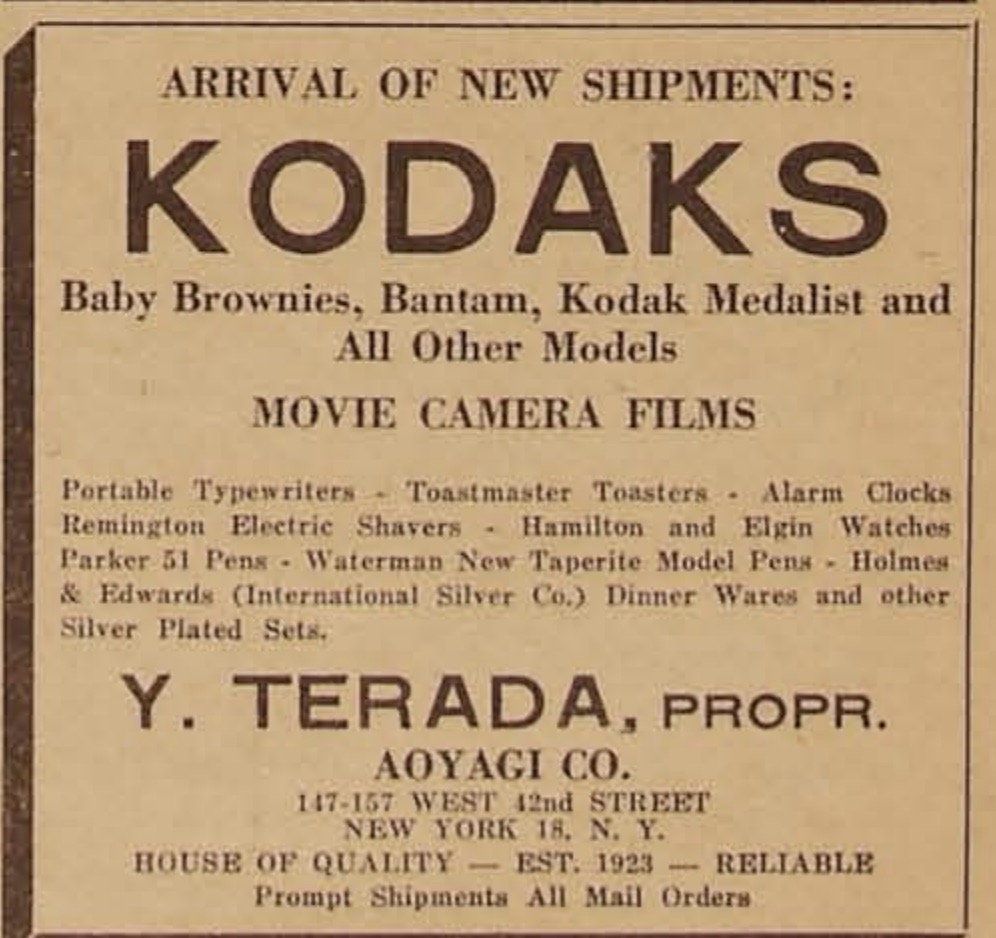
Suki Terada Ports was born in New York City in 1934. Her parents had met while studying at Columbia University. In 1941 her Hawaiian-born father, Yoshio Terada, was working at the Times Square store, Aoyagi and Company. Here, excerpted from a 2007 video interview of Suki Terada Ports by Julie Azuma, from The Digital Museum of the History of Japanese in New York* and used with permission from the Japanese American Association of New York, is a section of that interview, transcribed to tell the story of:
Tom, the Kodak film salesman
Told by Suki Terada Ports
“… on the day of Pearl Harbor my sister’s [friend’s] father, who worked at one of the New York newspapers, The Daily News, called my mother and said, ‘Tell your husband to come home right home… for his safety he’d better get home and, in the house, because I don’t know what’s going to happen.’
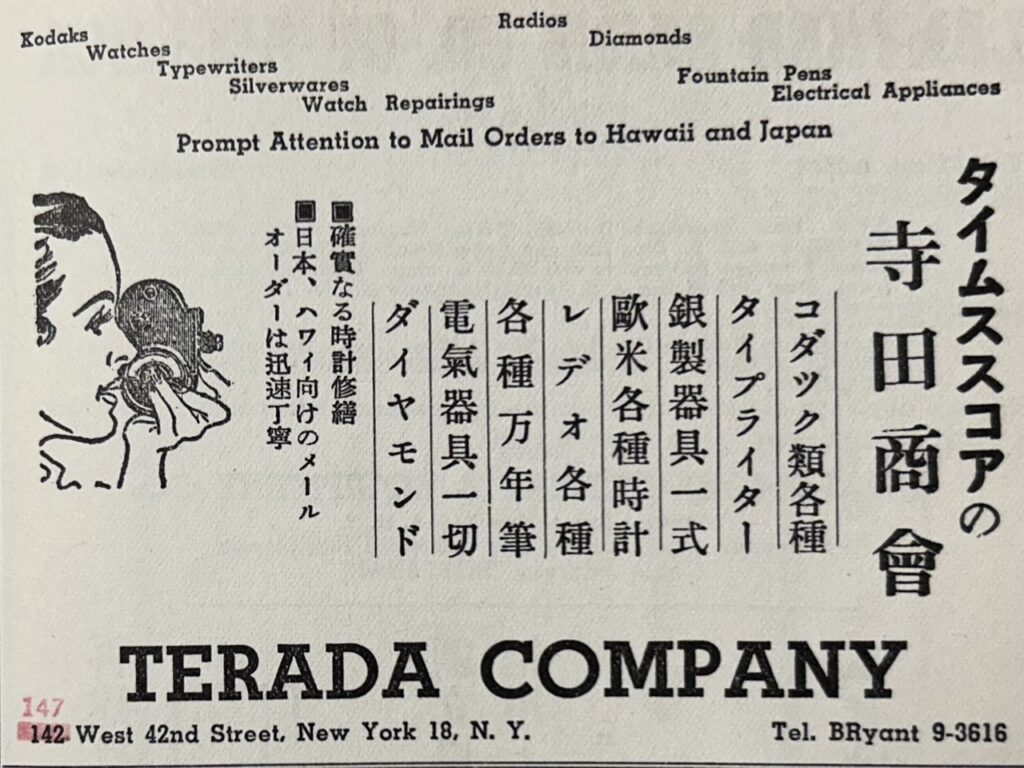
“… So my mother called and told him and Mr. Aoyagi to go home …. Mr. Aoyagi got sent to Ellis Island and eventually sent back to Japan … most of the kaisha people were sent back to Japan, so Daddy inherited a store because of the war. He promised Mr. Aoyagi that he would take care of his store for him during the war. Mr. Aoyagi said, “When the war is over, I’ll come back, so keep my business going.” That was a very hard time for my father because he all of the sudden had a new business but no customers, because most of the customers were sent back to Japan. And so, he had to start all over again. My parents taught my sister and me a lesson in, in the idea of trust, and being loyal to somebody … ” [She described the relative ease her father had in obtaining a bank loan, based on Mr. Aoyagi’s good reputation with the bank, to which he urged his family to forever remain faithful customers]. As Mr. Aoyagi never returned to New York City, the store became the Terada Company.
“… There was very little merchandise that my father had at the beginning — except for Kodak film, was something that they carried. One day the Kodak salesman [Tom] was sitting there waiting for my father’s lunch, he was waiting to take the — the two of them went out for a ‘liquid lunch’ – [smile] — the Kodak salesman was this very big hale and hearty Irish guy from Rochester, New York.”
“[Another] salesman came in and said, ‘Hey, Jap, I want all my merchandise, I don’t want to do business with you. Give me my merchandise, give me my money and I don’t want to have anything to do with you.’ So my father packed up his stuff and gave him the money for what he had sold.
“When he left, Tom, the Kodak salesman said, ‘Why didn’t you tell him you’re not a Jap?’
“My father said, ‘Because, in that man’s eyes, I’m a Jap and it doesn’t matter what I would say to him, he would think I’m a Jap, still.’
“And so, Tom said, ‘Well, don’t you worry, I will always give you Kodak film, and you will always have [film to sell] … ‘
“Well, what he (her father) didn’t know at that time was that eventually Kodak [film], because it has mercury or silver … it became a very hard thing to get during the war. Very few stores were able to get supplies of film, but my father was one of the few people who always had film, and that became one of his best products that he carried.
“People eventually wondered, ‘Why don’t you carry Polaroid, why don’t you carry this film, that film, and after the war why don’t you carry, you know, the different Japanese cameras’, and my father said, ‘No, we will only carry Kodak.’
“And I must say that, that when Tom’s funeral—- that was the only time I had ever seen my father’s tears coming, when we went to that man’s funeral. Because he had really helped our family survive during the war, with his delivery of Kodak.”
* Ports, Suki Terada. “Suki Terada Ports.” Interview by Julie Azuma, videography by Stann Nakazono, Digital Museum of the History of Japanese in New York, 2007. https://www.historyofjapaneseinny.org/artifacts/suki-terada-ports/
Suki Terada Ports, at age 90, was honored for her long time activism in support of many community causes, including HIV/AIDS, with her own park bench in Riverside Park, New York City on May 3, 2025: https://www.columbiaspectator.com/news/2025/06/25/longtime-activist-suki-terada-ports-honored-with-park-bench-in-riverside-park/ .
A 2014 profile of her from the Japanese American National Museum magazine can be found at https://discovernikkei.org/en/journal/2014/12/8/unusual-childhood/ .
ODG Post-story Note: An oral history excerpt from the American Friends Service Committee website, “Peace Works: A Century in Action,” highlights the difficulty in obtaining photographic film during the WWII. As a high school teacher in Manzanar, Helen Ely mentioned to others that the high school seniors were wanting a yearbook, with photos, naturally. She said of her then future husband, Bob Brill, “His parents lived in New York and he knew where to get film.” When four rolls of film from New York arrived at Manzanar, she presented them to the Los Angeles photographer, Toyo Miyatake, saying, “Look! It’s like gold!”
Brill, H. E. (2015). I was a volunteer. Peace Works: Century of Action. American Friends Service Committee. https://peaceworks.afsc.org/helen-ely-brill/story/223