“The remarkable cases I learned about happened in areas where people of different races shared a community – like the multicultural region of the Seattle Central District.”
“The diverse area created an opportunity for neighbors of different cultures
to get to know one another as friends.”
Uncle Marco’s Story about Papoo
Shared by Josh Tuininga, from his book, We Are Not Strangers
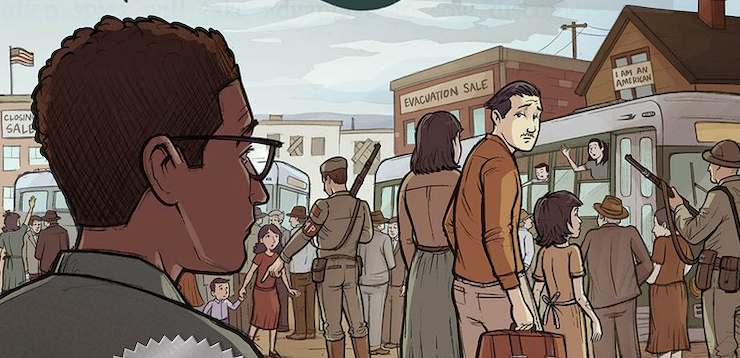
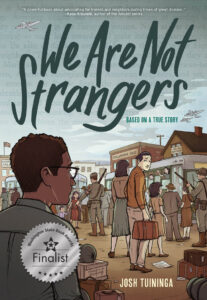
As this project launched its initial request for stories, we received enthusiastic and thoughtful perspectives from Josh Tuininga, author and illustrator of the graphic novel, We Are Not Strangers. While the ODG Project generally does not accept stories categorized as historical fiction, we carefully weigh any classification overlap with creative non-fiction. This book is based on the true story of people and events told directly to Josh by his uncle Marco, named after his grandfather (Papoo), Marco Calvo, a Sephardic Jewish immigrant. Josh’s research in historical archives and his conversations with people in the community fill an important gap in the understanding of relationships between the early Japanese immigrants and their neighbors.
In We Are Not Strangers, the decision of Marco Calvo to help his Japanese friend being forcibly removed from his Seattle home in 1942 was not simple and straightfoward, not fueled by unquestioned conviction. Most overseas relatives of Jewish immigrants had been killed by the Nazis in WWII; in Seattle as well, Marco was considered an unwelcome Jewish immigrant by some and so would further risk his family’s safety, including that of his undocumented immigrant mother, if he were to help his
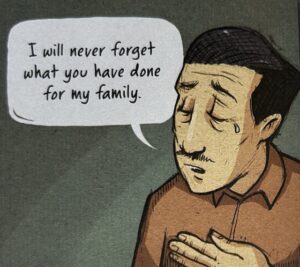
Japanese friends. He could not stick his neck out in protest. He knew Executive Order 9066 was a “disgrace” and that his Japanese friends had not done anything wrong, but he wanted to support Roosevelt in all war efforts to defeat the Nazis. He thought about it — beautifully depicted in silent graphics. He developed a legal and financial strategy with the Japanese family to manage their house and property while they were in the camps. Throughout the war years Marco did everything as secretly as possible, keeping a low profile. After the Japanese family came back from incarceration in the camps, he returned their house, property and financial matters back to them and told no one that he ever had anything to do with it.
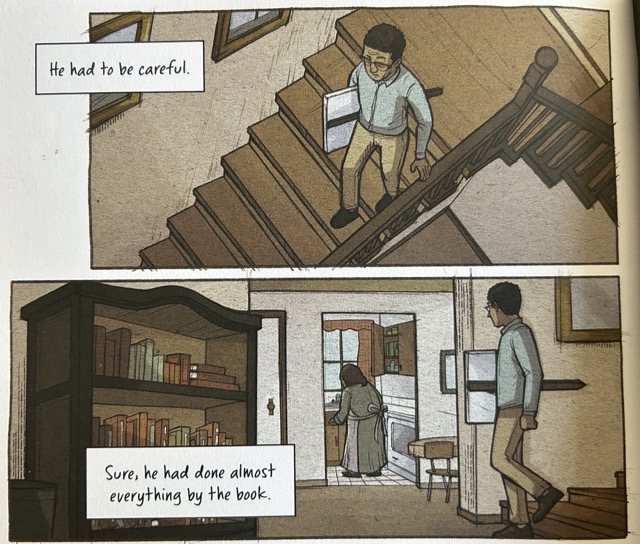
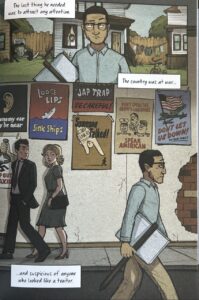
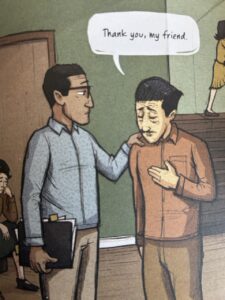
Why did Marco remain silent about it, even generations later when it was safe to talk about helping the Japanese? And how did this story finally become known to Marco’s family after he passed away? It’s in the book, along with wonderful graphic writing supporting the reader’s understanding of Japanese and Jewish political, cultural, and working lives in Seattle of those times.
In the “Author’s Note”, Josh Tuininga reflects on how hearing his uncle Marco’s story about his grandfather took him back to his own childhood memories when he would accompany his own grandfather from the Seattle suburbs into the city, walking through old Central District neighborhoods and visiting Pike Place Market. There, one of the stops was Mutual Fish, owned by the Yoshimura family for three generations. Josh’s grandfather was greeted with warm family-like recognition, and young Josh was introduced to the owners. The reader quickly obtains a sense that there was something valued in these trips to old familiar neighborhoods more than being a loyal customer. There were personal loyalties that grew there. They had begun there.
In research for his book, Josh Tuininga wrote about becoming aware of other stories of help to Japanese community members during WWII, which “highlight the type of environment where compassionate acts had the opportunity to unfold. The remarkable cases I learned about happened in areas where people of different races shared a community – like the multicultural region of the Seattle Central District. The diverse area created an opportunity for neighbors of different cultures to get to know one another as friends.”
All images © 2024, Josh Tuininga. Used with permission.
Josh Tuininga is an author, artist, and designer living in North Bend, Washington. A graduate of the School of the Art Institute of Chicago where he studied fine art, his work has been published in Communication Arts magazine and HOW design magazine, and he has been awarded the Communication Arts Award for excellence in illustration. His website is https://joshtuininga.com .
We Are Not Strangers is Josh Tuininga’s first graphic novel. Awarded a 4Cultural Heritage Grant, WANS was a 2024 finalist for the Washington State Book Award in creative non-fiction, and won the national 2024 Excellence in Graphic Literature Award for Best Young Adult Graphic Novel.