“a columnist for the California Eagle, an historic Black-owned newspaper …through his activism he publicly denounced the disparaging treatment of Japanese Americans in the United States
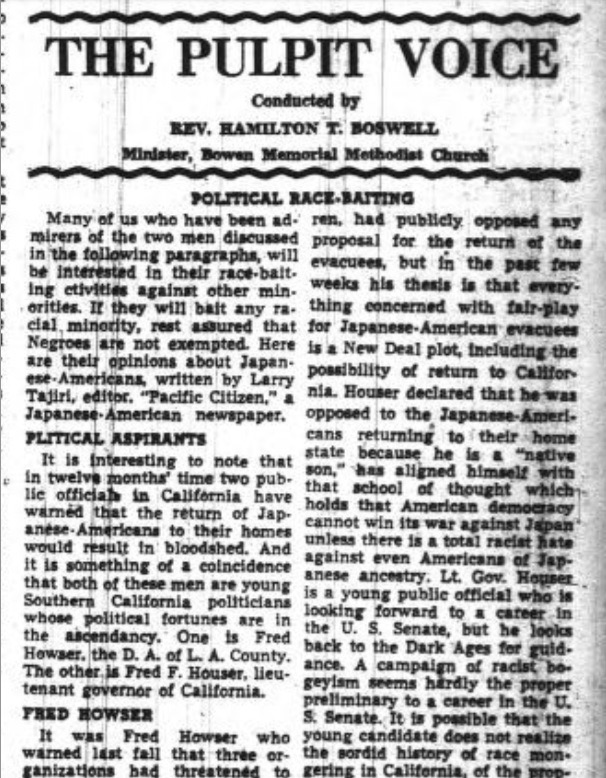
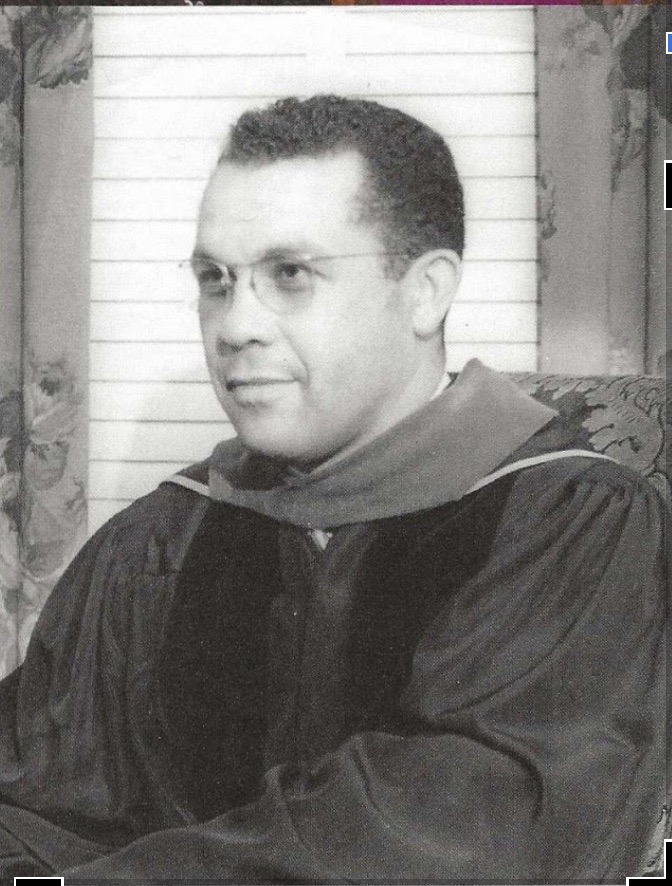
Image at left: Rev. Boswell’s editorial column in the newspaper, California Eagle, please see Ref.1 below, (1).
Photo at right: Rev. Hamilton T. Boswell as young pastor of Bowen Memorial Methodist Church, Los Angeles, CA, c.1943-47. Used with permission from Heritage United Methodist Church, Los Angeles, CA (2).
Rev. Hamilton T. Boswell
(1914-2007)
Editorial Columnist, “The Pulpit Voice” of California Eagle,
the long-established African American newspaper in Los Angeles,
while Pastor of Bowen Methodist Church, Los Angeles, 1943-1947.
Pastor of Jones Memorial Methodist Church in the Fillmore, San Francisco, 1947-1976
Greetings received from Deborah LeFalle
Greetings!
I first became aware of the Our Debt of Gratitude project from a flyer I received from Yu-Ai Kai Senior Center in San Jose, California. I was instantly drawn in and wanted to learn more, so I visited the website to read about it in more depth. I performed Internet searches to discover what I could about cooperative relationships of Japanese Americans and African Americans before, during and after World War II and came upon an article by Natasha Varner at densho.org titled “Intersections of Black and Japanese American History: From Bronzeville to Black Lives Matter.” In the article, reference was made to an excerpt in Scott Kurashige’s book, The Shifting Grounds of Race: Black and Japanese Americans in the Making of Multiethnic Los Angeles, wherein he sheds light on advocacy efforts within L.A.’s Black community to stand in solidarity with Japanese Americans in their struggle for equal rights.
A familiar name unexpectedly popped out at me: Hamilton T. Boswell. I said to myself, “Hamilton T. Boswell… that was the pastor of Bowen Memorial Methodist Church in the 1940s who presided over my parents’ marriage!” I learned from the excerpt that Reverend Boswell was a columnist for the California Eagle, an historic Black-owned newspaper, and that through his activism he publicly denounced the disparaging treatment of Japanese Americans in the United States. And I knew from the positive interactions my mother and aunt had with him, he was a compassionate catalyst for change in Black and other marginalized communities in Los Angeles and later San Francisco, where he relocated to lead Jones Memorial Methodist Church in “The Fillmore.”
After my father passed away in 1991 my mother moved the following year from Los Angeles to San Francisco to be with her sister (my aunt). As the universe would have it, Jones Memorial United Methodist Church is where she planted her spiritual feet – a full circle with close to five decades in between!
I realize this may not be the type of “helper” story you are seeking, but thought I would share it just the same. It made me think of how connected humanity truly is, and the good we can do in our unique and varied ways to uplift us all.
Thank you kindly and be well.
Deborah LeFalle
(Jan 6, 2026)
© 2026, Deborah LeFalle
Deborah LeFalle is originally from Los Angeles, but has lived in San Jose, California for 57 years. She has been a member of the Yu-Ai Kai Senior Center in San Jose’s Japantown for the last two of those years. After retiring from successive 20-year careers in local government and post-secondary education, LeFalle set out on a path to become a creative writer. Her poetry and prose have appeared in a variety of magazines and journals, and she has authored three chapbooks, one full-length book, and one children’s book. Beyond writing, she enjoys gardening, hiking, and engaging in the arts.
ODG Post-story Comments:
Reverend Boswell was also known as Rev. Dr. Boswell in the community. In 1935 his Debating Team from Wiley College, TX, an HBCU, famously beat the University of Southern California team. Upon graduating from Wiley, Hamilton Boswell enrolled at USC, earning his Masters and Doctorate in theology. After his ministry at Bowen Memorial Methodist Church in Los Angeles from 1943 to 1947, he and his family moved to San Francisco.
From “Celebrating the Life and Legacy of Hamilton T. Boswell. August 11, 1914 – May 6, 2007”, handed out at his memorial celebration at Jones Memorial United Methodist Church in San Francisco on May 15, 2007: “Boswell led his congregation beyond the church walls, establishing a formidable presence in housing, labor, justice and employment.” He was a community leader for numerous causes and campaigns that directly affected many lives. He was a spiritual and social activist, the first chairman of the San Francisco Conference on Race and Religion and co-chaired the Church Labor Conference, “the rallying force of San Francisco’s support of Dr. Martin Luther King, Jr.” Former San Francisco Mayor Willie Brown wrote in his tribute to his friend of 50 years, Rev. Dr. Hamilton Brown, that “he never hesitated to carry the good fight into larger arenas.”
*****.
The ODG project sometimes views it helpful to the reader to provide direct access to source information related to a story, especially when the Internet links require more persistent efforts. Los Angeles as a county was home to the largest percentage of the Japanese population in the U.S. before Executive Order 9066, ordering their forced removal in early 1942. As part of the decades of The Great Migration, African Americans continued to arrive in large numbers during WWII, occupying neighborhoods that Japanese had been forced to leave. A young pastor in Los Angeles in the 1940s, Rev. Dr. Boswell was a regular contributor to the editorial page of the well-established Black newspaper, the California Eagle. In his column, “The Pulpit Voice”, he educated his readers about the similarities among the economic plights of other marginalized groups, trying to promote understanding and cooperation instead of conflict. He called out organized fascism and institutional racist hatred aimed at Japanese, Mexicans, Native Americans and others. Thanks to exacting references in Scott Kurashige’s 2008 book, The Shifting Grounds of Race – Black and Japanese Americans in the Making of Multiethnic Los Angeles*, we offer the following California Eagle newspaper source links from Kurashige’s pages 165-166 about Hamilton T. Boswell. We hope readers will be encouraged to further learn about Rev. Dr. Boswell, study Kurashige’s book in more entirety, and pursue related works for thought in action.
*Kurashige, S. 2008. The shifting grounds of race – Black and Japanese Americans in the making of multiethnic Los Angeles, Princeton University Press..
For further information, and direct links to Rev. Boswell’s writings in California Eagle:
(1) Boswell, H. (1944, October 19). The pulpit voice: Political race-baiting. California Eagle, p.7. https://archive.org/details/la_caleagle_july_dec_1944/la_caleagle_july_dec_1944/page/n309/mode/1up (“If they will bait any racial minority, rest assured that Negroes are not exempted.” Rev. Boswell used much of his column space to also report the opinions of Larry Tajiri of the Pacific Citizen, identifying it as a Japanese-American newspaper, writing of the racial fear and hatred expressed by Frederick Houser, Lt. Governor of California, and the sensationalism of the hate-filled Hearst papers.)
(2) Heritage United Methodist Church, 112 W 52nd St. Los Angeles, CA 90037 , and 3522 Trinity St. Los Angeles, CA 90037. https://heritageumclosangeles.org/our-history/ (Wesley United Methodist Church, established in 1888, is considered a historical Black United Methodist Church and the mother church for the African-American Methodism in the West coast and Bowen Memorial United Methodist Church 1940. They are the mother churches for Heritage United Methodist Church.)
(3) Boswell, H. (1944, June 1). The pulpit voice. California Eagle, p.7. https://ia801608.us.archive.org/view_archive.php?archive=/12/items/la_caleagle_jan6_1944_jun29_1944/la_caleagle_jan6_1944_jun29_1944_pdf.zip&file=la_caleagle_jan6_1944_jun29_1944_pdf/la_caleagle_jan6_1944_jun29_1944_0397.pdf (“As a racial minority, Negroes cannot afford to overlook the evacuation of Japanese-Americans, authorized supposedly by military necessity.” Rev. Boswell begins here to reprint excerpts from “Outcasts”, by Caleb Foote, “to reveal the true causes of total evacuation of the Japanese,” citing economic figures.) https://credo.library.umass.edu/view/pageturn/mums1013-s02-b02-f110-i001/#page/1/mode/1up
(4) Boswell, H. (1966, July 6). The pulpit voice: Freedom for the American Indian”. California Eagle, p.7. https://archive.org/details/la_caleagle_july_dec_1944/la_caleagle_july_dec_1944/page/n8/mode/1up . (This page also includes an article about Blacks being turned down for blood transfusions in the article, “Of One Blood – All Men!” reminding the reader of Senator Daniel Inouye’s receiving 17 blood transfusions from the segregated African American 92nd Division.)
(5) A point well taken, we think [Editorial]. (1943, November 11). California Eagle, p. 8-A.
https://ia801604.us.archive.org/view_archive.php?archive=/17/items/la_caleagle_reel26/la_caleagle_reel26_pdf.zip&file=la_caleagle_reel26_pdf/la_caleagle_reel26_0297.pdf
(6) The eyes of the world are focused on California [Editorial]. (1945, January 4). California Eagle, p.7.
https://ia601802.us.archive.org/view_archive.php?archive=/25/items/la_caleagle_reel27/la_caleagle_reel27_pdf.zip&file=la_caleagle_reel27_pdf/la_caleagle_reel27_0009.pdf
(“Americans of Japanese ancestry had bought homes here …. With the usual arrogance born of ignorance and bigotry, they say … that these Americans born of a different race than their own shall not return to their former homes. They shall continue to live as outcasts. Why? For no other reason than that they are Japanese.” )
References above were originally found in: Kurashige, S. (2008). The shifting grounds of race. Black and Japanese Americans in the making of multiethnic Los Angeles. Princeton University Press.