“I thought I was the only person being helped, but to now realize how many other people like me he was helping at the same time is just mind boggling.
I can honestly say that he was truly my patron saint.”
ODG Pre-story Note: In 2003 a tribute entitled, KANSHA – honoring J. Elmer Morrish, was held in Redwood City. Among the nine speakers was Harry Higaki, whose daughter, Sharon Okamoto, contributed a transcript of his presentation, which we have condensed below. The program brochure noted that after his retirement, J. Elmer Morrish took a trip to Japan, sponsored by the Japanese residents he had helped during WWII.
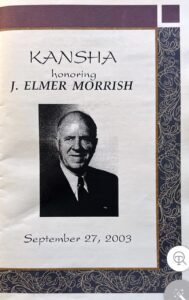
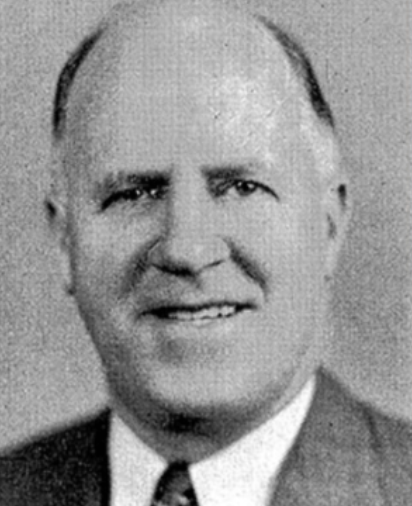
J. Elmer Morrish
(1886-1957)
Vice-President, First National Bank, Redwood City
By Harry Higaki
Presented on September 3, 2003 (condensed version)
I’m one of many beneficiaries of Mr. Elmer Morrish’s kindness and favors. The deeds of Mr. Morrish are so significant that it certainly transcends any words I may say, but it is certainly worthy of repeating over and over again.
I certainly was not aware of the magnitude of all the things Mr. Morrish did for so many Japanese families before, during and after World War II. I first learned from an article written last year in a local newspaper telling the story of Mr. Morrish, that there were more than 2000 documents in Mr. Morrish’s archive at the bank where Mr. Morrish managed. I understand that all the records are now at the library in Redwood City.
President Roosevelt, since being elected for the first time in 1932, came up with many good plans to get the country back on its feet economically. Under his leadership, many good things were accomplished, but as we all know, (in 1942) he allowed the greatest injustice in US history to authorize the denial of US citizens of Japanese ancestry of its rights by allowing “Executive Order #9066” to pass. As we all know, this gave the government the authority to remove all Japanese aliens and citizens alike without due process of the law to remove us from our homes into concentration camps.
Japanese people, including our parents, were denied US citizenship by law. Also, at that time, there was the statute in our state law called the Alien Land Law which denied non-citizen Japanese the right to buy and own land.
It was under these circumstances which Mr. Morrish operated. It certainly was not the most popular thing for Mr. Morrish to do what he did for the Japanese people of our community. Mr. Morrish was the manager and officer of the then called “First National Bank”. It was an independent bank which is now under the Wells Fargo Bank banner.
The day after World War II was declared on December 8th, 1941, my father was picked up by the FBI and sent to prison in Bismarck, North Dakota. Since I was the oldest child in the family, at the age of 21, I had to assume the responsibility to care for the family of now seven people.
I had to begin making financial arrangements with Mr. Morrish to help me prepare to move to Idaho. Our family did not wait for the government to put us into concentration camp – instead we voluntarily chose to evacuate to Idaho on a farm.
As we had to leave our home and nursery business to a tenant, I asked Mr. Morrish for help to take care of everything during our absence. When I think back to those days, I’m so amazed and grateful that Mr. Morrish accepted that responsibility without prejudice. After all, at the time, no one knew for how long or what the outcome would be for the future. Everything Mr. Morrish did was through his personal compassion for people like us. I’m sure this was not a part of his banking duties or responsibilities. He could have just as easily laid back and told us to do our banking wherever we decided to settle. All through the war years Mr. Morrish made sure that our tenant paid the monthly rental payment on time, and when the time came to pay our property taxes he made sure that the taxes were paid. Mr. Morrish always kept us informed by continuously writing us letters and even taking pictures of our property. The fact that our tenant knew Mr. Morrish was watching out for us made all the difference in the world.
I thought I was the only person being helped, but to now realize how many other people like me he was helping at the same time is just mind boggling. I can honestly say that he was my true patron saint. As we set aside this day to honor and pay tribute to Mr. Morrish, we are all eternally grateful for such a compassionate and humanitarian person.
Mr. Morrish was a soft spoken, sincere gentleman who could be trusted with your life.
I want Mrs. Margaret McWilliams, Mr. Morrish’s daughter, to know just how deeply indebted I am to your father. The transition from our evacuation and back to our normal, secure lives today could certainly not have been possible without your father’s love and help.
Once again, I want to thank you for your father’s life, and may God bless you.
Harry Higaki, Sept, 27, 2003.
Harry Harumi Higaki lived 101 years in San Mateo County, California. The family purchased property in the early 1900’s and ran a flower nursery. In 1942, following Executive Order 9066, Harry was forced to lease the business. The family relocated to Idaho where he was drafted to the Military Intelligence Service. He served as U.S. Army Sergeant in the Counter Intelligence Corps in Kobe, Japan where he met and married Sachiko Iwai. Post-war, Harry’s family nursery expanded and distributed flowers nationwide. He was a man of steadfast faith and expressed his deep gratitude numerous times throughout his life recognizing the significant impact Mr. Morrish made on our family history.
© 2026, Sharon Okamoto.
Photos attribute: Fair use by the ODG Project, for educational and non-commercial use only.
ODG Post-story notes:
The “Kansha” Tribute to J. Elmer Morrish noted that he was also treasurer of the Salvation Army, director of Children’s Health Home, and Redwood City Citizen of the Year in1956.
The Local History Collection at the Redwood City Public Library holds the anonymously donated “Morrish Collection, 1942-1958”, an archive of J. Elmer Morrish’s case files of Redwood City Japanese-Americans interned during the war: correspondence, tax bills, government forms and bank statements. More information is available at: https://oac.cdlib.org/findaid/ark:/13030/kt70002161
Based on letters and documents in the “Morrish Collection, 1942-1958”, Linda L. Ivey and K.W. Kaatz, authored the 2017 book, Citizen Internee – A Second Look at Race and Citizenship in Japanese American Internment Camps, published by Praeger, ABC-CLIO, Santa Barbara, CA. Interned and denied their rights as citizens and legal residents, Japanese Americans were still expected to be good citizens, paying their property taxes while forced out, unable to conduct business or farm their land – quite the altered idea of citizenship.
On November 23, 2024 the Topaz Stories Project shared stories about WWII “Friends and Allies of the Japanese American Community.” In tribute to J. Elmer Morrish , a narrative can also be found on their website, https://topazstories.com/friends-and-allies-photo-gallery/4/ , noting that he made many trips to Tanforan Assembly Center (San Bruno, CA) and then continued his correspondence with Japanese Americans during their further removal to Topaz, in Utah.