“The Tanforan Library was both the first and certainly the best
of the 14 libraries in the temporary detention centers”
(Wertheimer, 2004)(1).
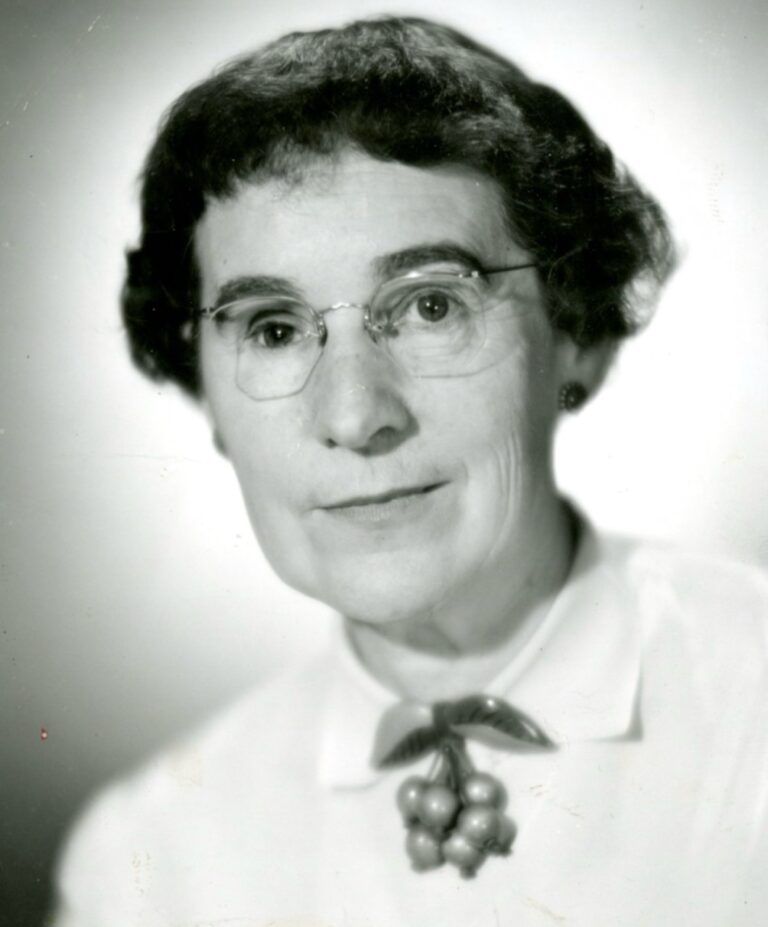
Evelyn Steel Little
(1895-1972)
“This is your library … ready to serve your needs, which are of two kinds,
information … and something we might call wings for your spirit …”(2).
By Margret Mukai
Mrs. Little. As a child, I knew when her name was about to be mentioned. My mother would be in a blur mumbling something about horse stalls, sandstorms, barbed wire, an elderly man shot dead.
Then she’d look at me and say that Mrs. Little had all these books sent to “camp”… more and more books. They couldn’t keep up with it.
Kyoko Hoshiga entered incarceration at Tanforan Assembly Center with the notion to ask to start a library, and unsure she could do it. In a distant barrack, she opened the Tanforan Library seven days later, May 4, 1942, “with 65 books and a mass of inconsequential periodicals”(3). My mother was just winging it.
Then, “books started arriving, they kept coming, more the next day, and the next day….”
On the other side of the barbed wire, Mrs. Little had spread the word, organized collections, and book donations flowed in. Kyoko assembled a small staff, including Mary Ogi, who eventually left Topaz for library school in Denver, writing, “From the very first trying days, the library’s most interested sponsor, Mrs. Evelyn Steel Little, Head Librarian at Mills College, was an invaluable friend … the staff considered her their guiding light”(3).
The proper cataloging, organizing, and running a true library from physical construction to book circulation was nonstop work. It had to run smoothly, to serve “relocation” chaos with calm, to offer knowledge and “wings” of spirit to disrupted lives. In six weeks it looked like this:
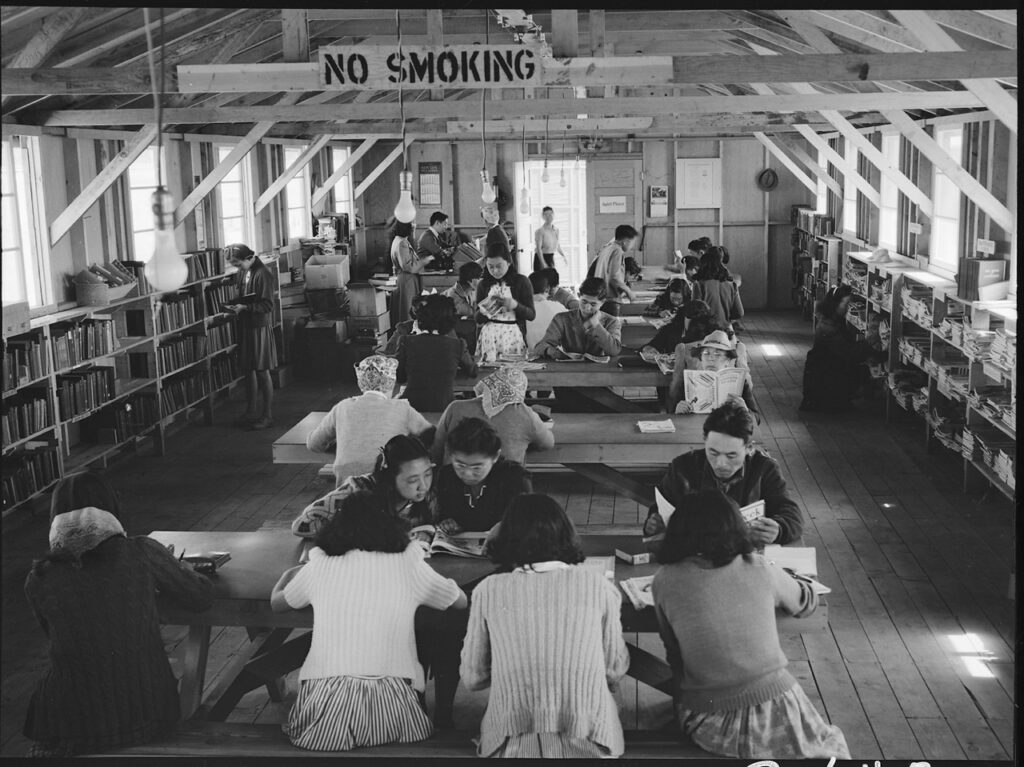
Highly respected among Bay Area librarians and academicians and with a “gallant lady”(4) personality, Mrs. Little spearheaded the donations of books to Tanforan, with a notable 400 coming from the San Mateo County library alone. “The Tanforan Library was both the first and certainly the best of the 14 libraries in the temporary detention centers,” wrote Andrew Wertheimer in “Japanese American Community Libraries in America’s Concentration Camps, 1942-1946″(1).
During the week of August 15th, 3,871 visits were logged; when it closed after four months on Sept. 1, 1942, 6,000 books were packed in 55 crates, and 67 cartons of magazines were ready to be shipped to become the start of the Topaz Library(1).
When Mrs. Little visited Tanforan to catalog books and advise, she was sometimes denied entry. “If you did anything for the Japanese, the FBI trailed you,” my mother emphasized.
Mrs. Little was the unstoppable driving force behind thousands of donations of reading materials for the thousands of Japanese Americans who used the Tanforan and Topaz libraries from 1942 to 1946. Having been among the first to encourage East Asian language library collections in California, she must have truly regretted that Japanese language materials were banned in the assembly centers, a deep hardship on the Issei. My mother always wished that Mrs. Little would had been better recognized and thanked by Japanese Americans. However, during the move from Tanforan to Topaz, Kyoko Hoshiga fell ill, and remained bedridden in Topaz Hospital for over two years. Otherwise, she might have continued on as director of the Topaz Library at least for some time and made sure Mrs. Little had been duly honored. It opened on Dec 1, 1942 with 5,000 volumes from Tanforan Library, a surprising 2,000 from Santa Anita Assembly Center(4), and some from local Nikkei, Ogden JACL and others(1). Mrs. Little advised the Topaz library from afar in limited correspondence until taking a leave from Mills College in 1943 to help direct the American Library in London(4).
Only recently have I learned about Mrs. Little on my own. In 1922, struck with “love at first sight”(4), she married a British barrister and went to live in India, traveling widely in Asia. Four years later on a golf course in Ceylon, a golf ball headed right towards her face, her spectacles — shattering the glass of one lens into her eye. She lost that eye. She was fitted with a glass eye in London. Just months after that, Mr. Little accidentally drowned in India. The young widow returned to California. Then, in 1931 she enrolled in a PhD program in Library Science and English at the University of Michigan(4). She was really Dr. Little, Professor of Comparative Literature at Mills College, but seemed to prefer Mrs. Little at the library, where she had hired my underemployed musician mother.
After WWII, Kyoko Hoshiga married and relocated to New York. The youngest of four children, I entered grade school in 1959, freeing her of overtime motherhood; her migraines and rheumatoid arthritis went into spontaneous remission. As Kyoko graduated with her Master’s in Library Science, her Master of Music degree chimed in, winning her a large Rockefeller grant to start one of the first music collections in a community library, now known as audio-visual sections. She rose in directorship to be able to effect many progressive changes, which did not go unchallenged. With her quiet, Meiji-era type ways and librarian’s pledge of service without regard to personal, political or social views, she would never be identified as an activist, but into her 90’s she marched for others and marched out of her own incarceration trauma, inspired by an inner Mrs. Little.
Margret Mukai, 2025.
Sources, and for further interest:
1) Wertheimer, A. B. (2004). Japanese American community libraries in America’s concentration camps, 1942-1946 [Doctoral dissertation, University of Wisconsin-Madison].
(2) Stanford University. (1938, September 1). Pathways of reading [Radio broadcast]. The Stanford Hour. Palo Alto, CA.
(3) Ogi, M. (1943, May 1). The Tanforan Assembly Center library. Library Journal, 68, 352–354.
(4) Reynolds, F. E. (1970, April). Evelyn Steel Little. California Librarian, 31, 126–128.
With many thanks to Rebecca Leung of Northeastern University, Oakland, CA (Mills College) and to Barbara Goto of El Cerrito, CA, for obtaining these references, not readily available online.
Margret Mukai is a retired RN and family nurse practitioner who worked primarily in the clinical fields of adult and pediatric HIV/AIDS, respiratory and cardiology, and in rural health with Planned Parenthood and with adults with developmental and intellectual disabilities. In drug development, she managed international clinical trials and drug safety research. She had a prior career as a plant physiologist in postharvest loss reduction and food science.

This content is offered under offered under Creative Commons license CC BY-NC-SA Attribution-NonCommercial-ShareAlike 4.0 International. You are free to use, share and remix this content as long as you attribute the work, only use it for non-commercial purposes, and offer any work that builds on the content under these same conditions. For more information, please click on the icon for license details.