” We must also remember those who had the courage of their convictions
to stand up against the government and who tried to help Japanese Americans at the expense of their careers and reputations.”
“They, like Bob Fletcher, are heroes and must not be forgotten.”
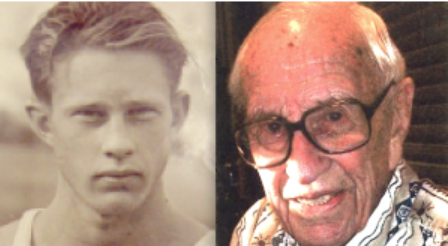
Bob Fletcher,
a Friend of the Japanese American Community
By Gerald H. Yamada
In 1942, he was a state agricultural inspector who did not agree with the government-ordered evacuation and felt that Japanese farmers had nothing to do with Pearl Harbor. He quit his job and went to work saving farms owned by the Nitta, Okamoto and Tsukamoto families in Florin.
Driven by his principles, he gave up his career to care for these farms. He suffered harsh criticism within the white community for his views.
My mother was the oldest daughter of the Nitta family, whose farm was one of three Florin farms that Mr. Fletcher saved during World War II. My parents and grandparents were imprisoned at the Jerome War Relocation Authority Camp in Arkansas, where I was born. After the war, Mr. Fletcher returned the farm to my grandparents, and they continued to farm it for the next 40 years.
My parents and grandparents never talked to me about their internment experience. Whenever the war was mentioned, my mother only mentioned how grateful she was for Mr. Fletcher’s efforts in saving her parents’ farm. I have very fond memories about my grandparents’ farm and thank Mr. Fletcher for making a difference. He will be missed.
There is a lesson for us here. As Japanese Americans, we tend to focus on the prejudice, hatred, distrust, and disloyalty aimed towards persons of Japanese ancestry resulting in the forced evacuation of 120,000 persons from the West Coast. We must also remember those who had the courage of their convictions to stand up against the government and who tried to help Japanese Americans at the expense of their careers and reputations.
They, like Bob Fletcher, are heroes and must not be forgotten.
© Gerald H. Yamada, 2013.
Originally posted online on Rafu Shimpo, on June 7, 2013 as “In Memory of Bob Fletcher, a Friend of the Japanese American Community” by Gerald Yamada.
https://rafu.com/2013/06/in-memory-of-bob-fletcher-a-friend-of-the-ja-community/
Gerald H. Yamada is an attorney based in the Washington, DC area. In October 2025 he was honored with the “Commendation for FY 2025” from Japan’s Ministry of Foreign Affairs for “his dedicated service in promoting mutual understanding between Japan and the United States.” From 2011-2024, he served four terms as president of the Japanese American Veterans Association (JAVA). In 2004, he organized a 33-organization coalition that successfully secured passage of the Japanese American Confinement Sites Grant Program that is preserving the story of Japanese American imprisonment during World War II. He served as pro bono General Counsel of the National Japanese American Memorial Foundation (NJAMF) from 1996-2005 and was NJAMF’s Executive Director from 2005-2010. Through presentations and writings, many of which included his personal experiences, he continues to work in promoting awareness and forward thought of Japanese Americans and their history.
ODG Post-story Note:
“The people ransacked all the houses, I remember that… they said, oh, we went in and got this and that.” In a 1995 interview with Bob and Teresa Fletcher, Teresa recalled the advantage taken by area residents after Japanese Americans were forced out of their homes, businesses, and farms to the camps.
Fletcher, R., & Fletcher, T. (1995, April 29). Oral history interview with Robert and Teresa Fletcher, part 2 (E. Pinkerton, Interviewer) [Audio recording]. California Revealed, California State University, Sacramento. https://californiarevealed.org/do/35bb7e05-c0b0-453d-8e5c-430e36daf091
Even with the Fletchers moving into Bob’s grandparents’ house, stored items in the garage were gone when the family returned (personal communication from Gerald Yamada to M. Mukai, Dec. 20, 2025). In the 1995 interview, Bob Fletcher shared a remorseful memory – that he could not protect everything that was left in his care from loss and robbery.
The Tsukamoto farm was also saved by Bob Fletcher, in his tirelessly working to maintain not one, but three working farms, and is detailed in the book, We the People: A Story of Internment in America, by Mary Tsukamoto and Elizabeth Pinkerton, published in 1987 by Laguna Publishers. It is available as open access on Internet Archive: https://archive.org/details/wepeoplestoryofi00tsuk/page/296/mode/2up
The Robert Emmett Fletcher Jr. Humanitarian Award was recently established by Lisa and Michael Kanazawa through the JACL. On July 19, 2025, its inaugural award was presented to the University of Southern California (USC) president, Dr. Carol Folt, who used her authority to override an institutional policy that two of her predecessors had declined to use. As a result, honorary posthumous degrees were finally granted from USC to its students of Japanese heritage who were expelled during wartime.
P.C. Staff. (2025, August 8). Rewarding action. Pacific Citizen.
https://www.pacificcitizen.org/rewarding-righteous-action/